

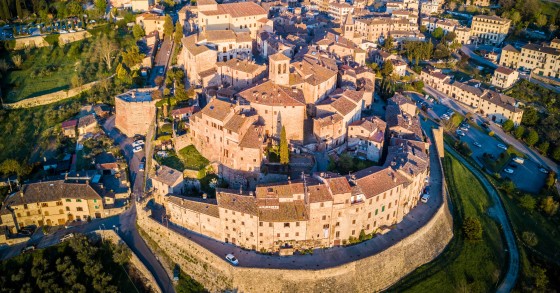
Anghiari: the village that preserves Leonardo's "secret"
Perched above the Valtiberina valley, Anghiari is one of Tuscany’s most celebrated villages for its history, scenic overlooks and commitment to slow tourism. Recognized with quality and heritage awards, the village offers quiet lanes, museums and countryside views over the plain where the Battle of Anghiari was fought in 1440.
Why visit Anghiari
The town is notable for both its picturesque streets and the historical memory of a major Renaissance commission: Leonardo da Vinci’s planned depiction of the Battle of Anghiari for Florence’s Salone dei Cinquecento. Although the fresco was never completed, the event is interpreted through local exhibitions and storytelling.
What to see in the historic center
Take your time to explore churches, towers and panoramic viewpoints. Key stops include:
- Badia di San Bartolomeo – the main church, with a late 13th-century wooden Crucifix and a Madonna and Child attributed to Tino di Camaino.
- Orto del Vicario – a small medicinal garden and shaded viewpoint over the valley.
- The Campano – the clock tower rebuilt in the 17th century, a defining feature of the village silhouette.
- Church of Sant’Agostino – houses a 16th-century polychrome terracotta attributed to Santi Buglioni.
Museums and historic buildings
The Museum of the Battle and of Anghiari in Palazzo Marzocco (Piazza Mameli) presents artefacts from prehistory to Roman times and detailed displays about the 1440 battle and the lost Leonardo work. Nearby, the Palazzo Pretorio displays carved vicars’ coats of arms and a 15th-century fresco.
Surroundings: castles and parish churches
The surrounding countryside is dotted with medieval and Romanesque sites:
- Montauto Castle – nearly 800 m elevation, with medieval to 19th-century additions; historically linked to the Franciscan heritage.
- Galbino Castle – square plan with corner towers and a stone loggia, evolved into a noble residence.
- Pieve di Santa Maria alla Sovara – a pre-Romanesque church with three apses dating back to the 8th–9th centuries.
Nature and trails in the Valtiberina
Between Anghiari and Sansepolcro lies the Monti Rognosi Nature Reserve: 156 hectares of marked trails suited for hiking, mountain biking and horseback riding. Paths trace the historic "mine road" and routes connected to local spiritual and Franciscan traditions.
How to get there and practical tips
By car: from Florence take the A1 to Arezzo and continue on SP43 through rolling countryside. From Siena and the coast it’s often quicker to pass through Florence. By public transport the nearest rail hub is Arezzo; bus or taxi connections serve the Valtiberina.
Visitor tips:
- Best time – spring and early autumn for mild weather and scenic color; weekdays are quieter than weekends.
- Where to sleep – local B&Bs and agritourisms offer authentic stays and proximity to nature.
- Suggested length – half a day for a center stroll, 1–2 days to include museums, castles and trails.
Summary
Anghiari is an excellent destination for slow travel lovers who appreciate historic villages, interpretative museums and natural paths in the Valtiberina. A compact but rich itinerary links panoramic viewpoints, Romanesque churches and traces of a Renaissance mystery.
Where it is
Location: Piazza Goffredo Mameli, 1, 52031 Anghiari AR, Italia
Coordinates: 43.5408366, 12.0564764