
Autore: Giansalvo Pio Fortunato • 16/01/2026 10:47
Abruzzo, a region of breathtaking panoramas and a wild soul, safeguards some of the most authentic and evocative mountain trails in Italy. Within the four national parks that shape its territory – including the Abruzzo, Lazio and Molise National Park, the oldest in the Apennines – wind paths that tell stories of nature, traditions, and unique biodiversity. In this region where the sea meets the peaks, we propose three itineraries distinct in difficulty and characteristics, yet united in their capacity to deliver unforgettable experiences.
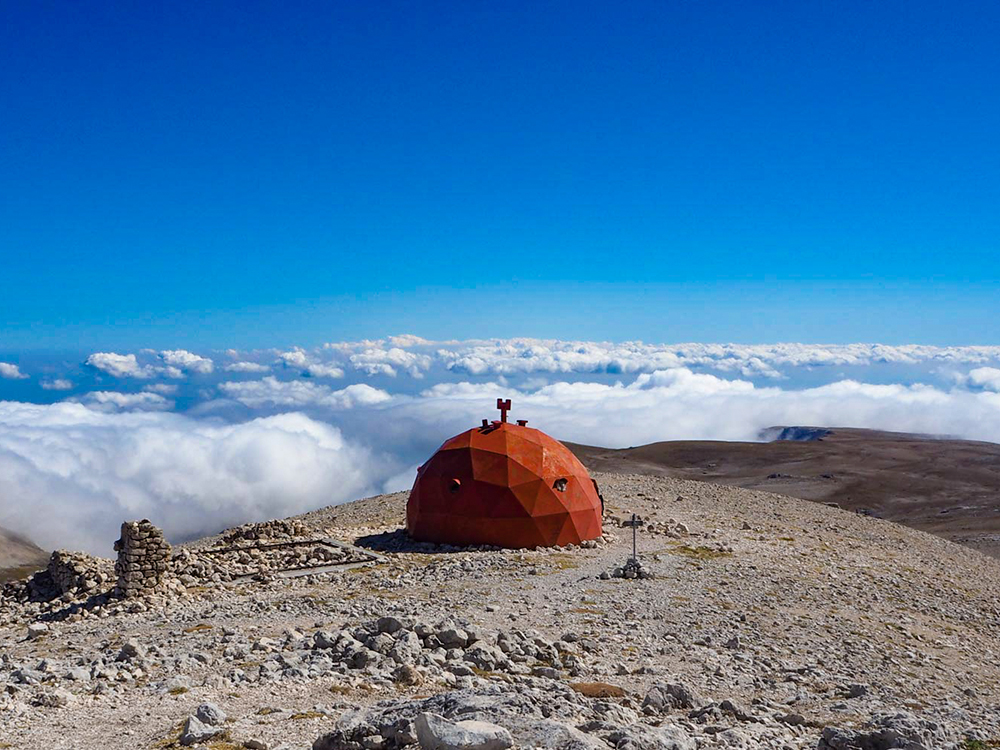
Elevation Gain: 1,700 m | Length: 13 km | Difficulty: E (Experienced Hikers) | Duration: 7-8 hours
Monte Amaro (2,793 m) is the second-highest peak in the Apennines after the Gran Sasso and dominates the Majella National Park, a mountain sacred to the people of Abruzzo. The loop that traverses its slopes is perhaps the most emblematic itinerary in the region, a journey through layered ecosystems and landscapes that change with every step.
Start and Route: The hike begins at Blockhaus (2,140 m), a historic military observatory reachable from Passolanciano. From here, the trail heads towards the Sella dei Due Cavalli (Pass of the Two Horses), first crossing monumental beech forests, then expanses of wind-twisted mountain pine. After crossing the saddle, one overlooks the Vallone di Femmina Morta (Valley of the Dead Woman), a suggestive karstic plateau that hosts, in spring, blooms of gentians and rare endemic botanical species.
The true ascent begins towards Cima delle Murelle, with a path that becomes steeper and requires attention. From the summit of Amaro, the panorama is boundless: to the northeast the Gran Sasso, to the south the Costa dei Trabocchi on the Adriatic, to the west the Valle Peligna and the Monti Marsicani. On the summit, the C. Jacomini hut (always open) offers shelter.
The descent follows the opposite side, passing by the Calderone Glacier (the southernmost in Europe, now reduced to a snowfield) and skirting the imposing north walls of the massif. The loop trail allows one to appreciate the geomorphological diversity of the Majella: from the lunar landscape of the summit plateaus to the green lateral valleys.
Peculiarities: This itinerary is a journey through natural history: you walk on an ancient emerged sea floor, among visible fossils and caves that were the hermitages of Pietro da Morrone (Pope Celestine V). In spring, it is a unique botanical spectacle, with over 2,000 plant species, including the Apennine edelweiss (Leontopodium nivale) and the Spring Pheasant's Eye (Adonis distorta).
Tips: It is essential to start at dawn, bring plenty of water (there are no springs at high altitude), and dress in layers: conditions at the summit can change abruptly. Recommended period: June to September.
Elevation Gain: 800 m | Length: 10 km (out and back) | Difficulty: E (Hikers) | Duration: 5 hours
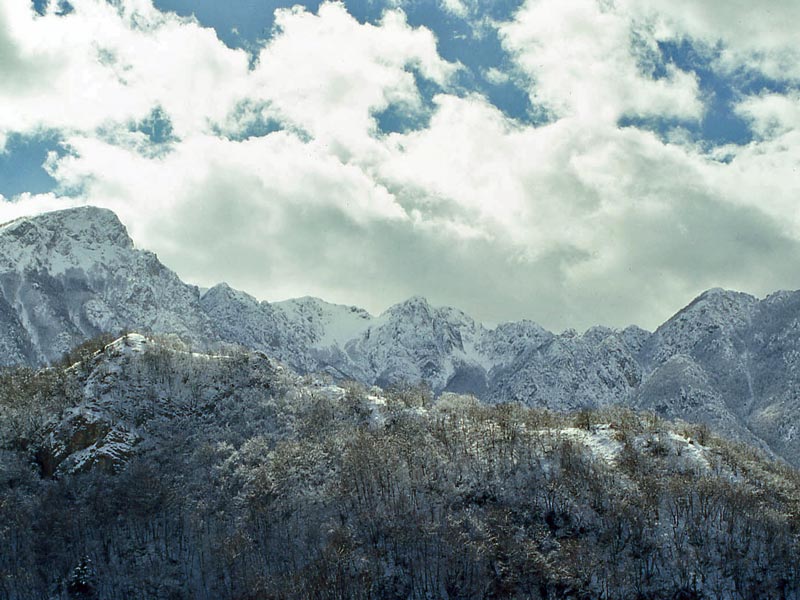
For those who wish to immerse themselves in the most authentic nature with the possibility of encountering the symbolic fauna of the Apennines, the Valle Cannella (Cinnamon Valley), in the heart of the Abruzzo National Park, is an unparalleled experience. This itinerary is not a loop, but a slow and respectful penetration into one of the best-preserved ecosystems in Europe.
Start and Route: The hike starts from the village of Civitella Alfedena, a medieval hamlet known for its Wolf Museum. From the center of the village, you descend towards Lake Barrea, skirting its shores for a short stretch, before entering the wide and wild Valle Cannella. The trail gently climbs along the stream, crossing ancient beech forests where, with patience and luck, it is frequent to spot deer, roe deer, and, in the more remote areas, perhaps the rare Abruzzo chamois.
Midway, you encounter the Camosciara (Chamois Reserve), an integral reserve of the park and the stage for an extraordinary rock face sculpted by glaciers. Here the valley narrows and the path becomes more challenging, but the effort is rewarded by the beauty of the place, an ideal habitat for the chamois. The traditional endpoint is the Fonte della Defensa, a very fresh spring at the foot of the cliffs.
Peculiarities: This is the kingdom of Apennine fauna. In addition to the aforementioned ungulates, it is possible to spot the Marsican brown bear (requiring prudence and respect), the golden eagle, and, at dusk, to hear the howl of the Apennine wolf. The trail is also a lesson in conservation: you cross areas with varying degrees of protection, testifying to the success of environmental protection started a century ago.
Tips: Binoculars and a camera are essential. Absolutely respect the park's instructions, do not leave the marked trails, and do not approach the animals. The best periods are late spring for the deer births and autumn for the males' rutting call (bramito). Booking a park guide can greatly enrich the experience.
Elevation Gain: 550 m | Length: 9 km (out and back) | Difficulty: T (Tourist) / E (easy) | Duration: 4 hours
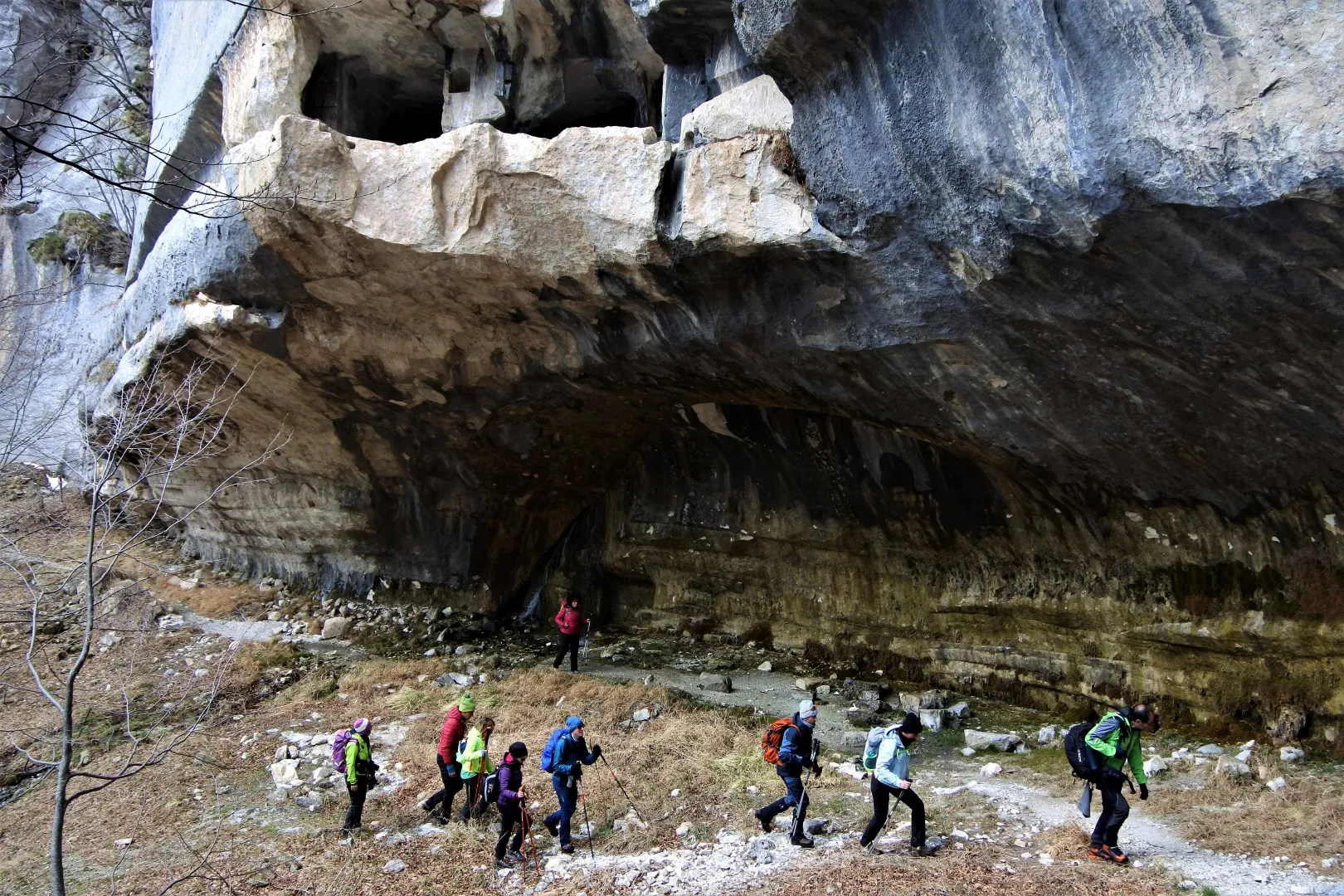
For those seeking an itinerary with great scenic impact without excessive technical difficulty, the Celestino Trail on the Teramo side of the Gran Sasso is perfect. This path connects two jewels: the hermitage of Santa Colomba (1,650 m) and Lake Pietranzoni (1,850 m), offering continuous views of the Monti della Laga chain and the underlying Valle del Vomano.
Start and Route: The hike starts from Piano Vomano, reachable by car from Castelli or Isola del Gran Sasso. Trail no. 4 (red-white-red markers) immediately enters a splendid beech forest, with centuries-old trees with silvery bark. The climb is gradual and well-marked. After about an hour and a half, you reach Lake Pietranzoni (also called Lake Santa Colomba), a glacial-origin body of water nestled among the beeches, an ideal resting place.
Continuing beyond the lake for about 30 minutes, you reach the remains of the Santa Colomba Hermitage, a meditation place for the future Pope Celestine V, Dante's "pope of the great refusal." The location is spectacular: a natural balcony overlooking the valley. The return follows the same route, but the opposite perspective offers new emotions, especially in the late afternoon when the light is low.
Peculiarities: This itinerary unites nature, history, and spirituality. It is a trail suitable for families with fit children and offers a taste of the Gran Sasso environment without tackling its more challenging peaks. In autumn, the beech forest transforms into a kaleidoscope of colors from yellow to fiery red, an unforgettable spectacle. The lake, often populated by wild ducks, is a serene place for a prolonged rest.
Tips: Although a relatively easy trail, hiking boots are always necessary. Bring a packed lunch to enjoy by the lake. On the return, don't miss a stop in Castelli, the home of Abruzzese ceramics, to visit its historic workshops.
Whatever itinerary you choose, some fundamentals are essential. The Abruzzo mountains are authentic and often remote: huts are not always open, trail markers can be sparse in some areas, and the weather changes rapidly. It is therefore essential to: study the route, consult the bulletins of the Club Alpino Italiano (CAI) and Mountain Rescue (Soccorso Alpino), communicate your itinerary to someone, always carry water, food, layered and rainproof clothing, and detailed maps.
But above all, hiking in Abruzzo requires an attitude of deep respect. You traverse fragile ecosystems, protected areas, and often share the trails with wildlife. Leave only footprints, take only photographs, maintain silence to listen to the true sound of the mountain: the wind through the beeches, the whistle of the marmot, the gush of spring water.
These three itineraries represent only a taste of the infinite possibilities offered by the Abruzzo mountains. They encapsulate the essence of a region that has made its harsh and splendid nature a reason for life and identity. To traverse them means not only to go hiking, but to undertake a journey into the most authentic soul of the Apennines, where every trail tells a millennia-old story of stone, sky, and freedom.

In small, middle-class Milan, near the Villaggio dei Giornalisti, temporary housing units were built...

We are in the early 1960s. On one side there is Enzo Ferrari, the "Drake", absolute monarch of the a...

From April 13 to 16, 2026, the Bologna Children’s Book Fair returns for its 63rd edition. Once again...

In 1291, Doge Pietro Gradenigo signed a decree that would forever change the history of European cra...

Tornano sabato 21 e domenica 22 marzo le Giornate FAI di Primavera, il più grande evento di pia...

2026 is approaching, and with the date set for Sunday, April 5th, the first real long weekend of spr...
Rivista online registrata al Tribunale di Napoli n. 43 del 23/03/2022
Direttore: Lorenzo Crea
Editore: Visio Adv di Alessandro Scarfiglieri
Insight italia srl (concessionario esclusivo)
Rivista online registrata al Tribunale di Napoli n. 43 del 23/03/2022
Direttore: Lorenzo Crea
Editore: Visio Adv di Alessandro Scarfiglieri
Insight italia srl (concessionario esclusivo)
