
Autore: Michele Spinelli • 15/04/2026 13:03
There is a sound that never fades. Not the kind that dissolves into the air, but that of bronze bells, which remains suspended among the mountains, among the stones of churches and the hearts of those who have listened for centuries. It is the sound of Agnone, a village of a few thousand souls clinging to the slopes of Molise, where bronze is not merely melted: it is transformed into a voice. A voice that, starting from a foundry hidden among the narrow alleys of a town that seems out of time, has crossed oceans, wars and revolutions, carrying its song to every corner of Christendom: from the bell towers of Buenos Aires to abbeys rebuilt from rubble, to the most remote squares where faith makes its way in silence. Here come to life the famous bronze bells of Agnone, a historic production of bells that have travelled the world, transcending the limits of time, bearing witness to the strength of the thousand-year-old tradition of the Marinelli family.
Agnone is not just a place. It is the beating heart of a tradition that has resisted invasions, wars and even the fury of the Second World War, when Molise was occupied, the foundry was turned into a headquarters and the bronze of bells into cannons. Yet the foundry survived. Not as a museum, but as a living workshop, where every bronze casting is still an act of faith in the future. Because in Agnone, tradition is not preserved: it is practiced, passed down, made to resonate. Like a rope that has been vibrating for a thousand years.
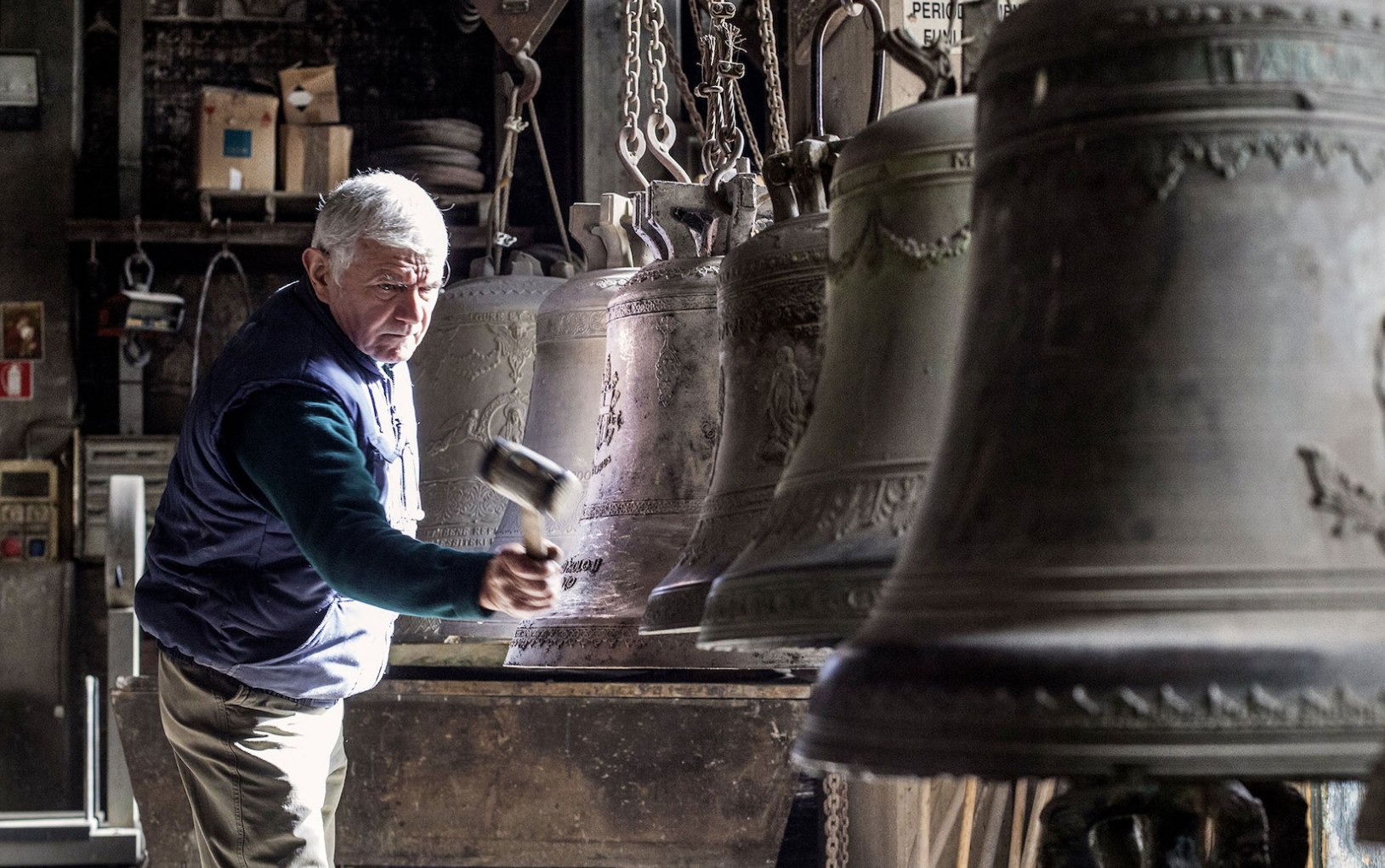
Agnone is an ancient mountain centre in Alto Molise, in the province of Isernia, known worldwide as the seat of the oldest bell foundry, whose foundation seems to date back to around the year 1000. This is not a legend fuelled by local pride, but a documented and internationally recognised record. The prestigious magazine "Family Business" ranked the company second among the oldest family-run businesses in the world, tied with the Chateau de Goulaine winery.
The town itself bears the marks of a rich and layered history. Agnone, whose origins are traced back to the fallen Samnite city of Aquilonia, experienced Lombard domination, Venetian influence and belonging to the Kingdom of the Two Sicilies. In 1139, the powerful Borrello family brought a considerable number of Venetian soldiers and artisans to the place, which greatly influenced the life and economy of the town. Over the centuries it became a cultural centre of importance, earning the title of "Athens of the Sannio". The most lasting sign of this artisanal and artistic vocation, however, remains that of molten bronze.
The family that carries on this tradition is called Marinelli. The 27th generation of founders currently operates there, the sole survivor of the various dynasties of bell makers that once animated Agnone. A biological and professional continuity without parallel in the Italian artisanal landscape. The first official bells cast by the foundry date back to 1339, by Nicodemo Marinelli, known as "Campanarus". But the roots go even deeper: the Marinelli Museum houses a rare example of a Gothic bell that tradition holds was cast a thousand years ago in Agnone.
The history of the Marinellis is not only a story of success. It is also a story of resistance. When the occupiers arrived in Molise in 1944, the foundry was closed and used as a headquarters. The bells being cast were destroyed and the bronze was recast to produce cannons. An act of symbolic violence before material: transforming the voice of churches into instruments of death. The recovery was slow, but as early as 1949 the foundry was entrusted with the task of casting the bells for the reconstruction of Montecassino Abbey. It was the signal that the Agnone art had not been broken.
The most significant recognition came in 1924. Pope Pius XI granted the Marinellis the privilege of bearing the papal coat of arms, and from that moment the Agnone factory became the **Pontifical Marinelli Foundry**. A title that no other foundry in the world can boast. In 1954, the President of the Republic, Luigi Einaudi, awarded the foundry the Gold Medal as the "oldest firm for activity and fidelity to work at the national level". The bond with the Vatican continued: on 19 March 1995, on St Joseph's Day, Pope John Paul II visited the foundry, which remained in his memory as the oldest workshop, rich in sacred and symbolic aspects, among those of the artisan world.
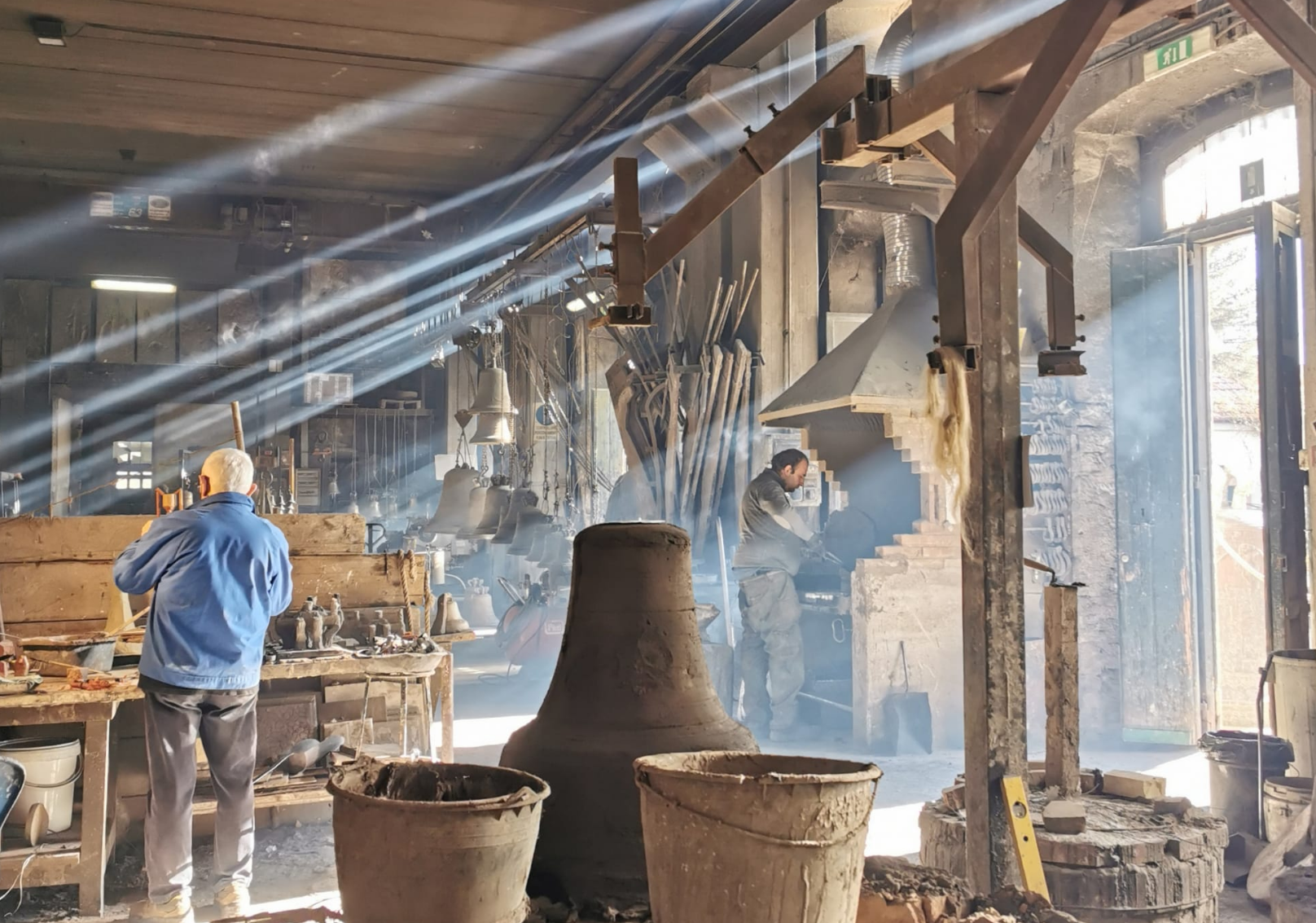
What truly makes a bell from Agnone unique? The answer lies in a production process that has remained substantially unchanged over the centuries. The bells of Agnone follow the dictates of a centuries-old Molisan artisanal technique made up of distinct and equally important working phases. Everything begins with the creation of a brick structure that corresponds exactly to the inside of the bell, onto which layers of clay are superimposed, onto which the friezes, inscriptions, coats of arms and decorative figures are then applied in wax.
This first structure is called the "core" (*anima*). On top of it, the so-called false bell is constructed, which precisely reproduces the definitive shape of the artefact. The bell's mantle is then prepared by applying, with a brush, further layers of clay, allowing them to dry one by one using charcoal lit inside the brick core, a process that allows the wax to melt. This is the "lost wax" technique, ancient and irreversible: each bell is born only once, because the mould is destroyed to extract it. This is why it is impossible to make two identical bells.
Bell bronze is an alloy composed of 78 parts copper and 22 parts pure tin. This proportion, refined over centuries of trials and corrections, guarantees the characteristic resonance of the Agnone sound. The production cycle lasts from thirty to ninety days or even more, moving from moulding to casting in pits and pouring the bronze, from cooling to polishing, up to the sound testing. This final phase is entrusted to music masters who use special instruments to detect the pitch produced by the newborn bell: not an industrial quality control, but the verification that a voice has found its note.
The destinations of these bells speak for themselves. The Pontifical Marinelli Foundry has been called upon from every part of the world for historical events: in 1958 for the centenary of the Sanctuary of Lourdes, in 1963 for the Second Vatican Ecumenical Council, and again for the Sanctuary of Medjugorje and for the "bell of Perestroika", which rang in 1989 on the occasion of the historic meeting between the Pope and Gorbachev. In 2000, for the Jubilee, the "Giovannea" bell was cast, commissioned directly by John Paul II. Among the most recent works are also the three "bells of duty" produced in 2013 for the oldest Italian military schools: the Nunziatella in Naples, the Teulié in Milan and the Military Academy of Modena.
Each bell is born as a unique piece because it bears personalised inscriptions and artistic decorations, shaped by expert sculptors in the delicate art of bas-relief. It is this artistic dimension, as well as technical, that makes each commission an unrepeatable creative act. Anyone who orders a bell in Agnone does not receive a product: they receive an artefact built around a specific story, a place, a community.
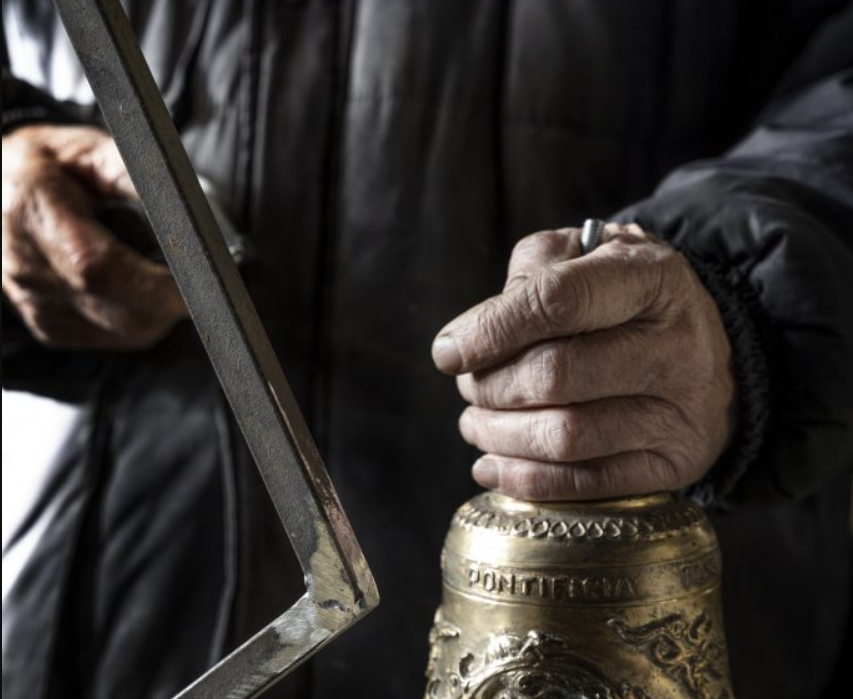
In 1997, alongside the foundry, the "John Paul II" Historical Bell Museum was born, where the visit lasts about an hour and includes the screening of a film on the working phases: artistic design, model construction, casting and testing. The museum is open every day with guided tours in several languages, and has become one of the reference points for cultural tourism in Molise. The oldest document it preserves is a Dutch edition from 1664 of Girolamo Maggi's treatise *De Tintinnabulis*, considered the Bible of every bell founder.
What strikes most about visiting Agnone is not only the historical stratification of the place but the living continuity of a knowledge that has not been archived and that continues to produce, to expand throughout the world, to fill new churches with sound alongside ancient ones.
In an era when mass production has redefined the relationship between the object and its creator, Agnone offers a rare example of resistance: not nostalgia, not folklore, but daily work passed from father to son through twenty-seven generations. A human chain that starts from the 13th century and reaches the present day, carrying with it the weight of bronze and the lightness of a sound that, once in the air, belongs to everyone.
Credit photos: museocampanemarinelli.it

In small, middle-class Milan, near the Villaggio dei Giornalisti, temporary housing units were built...

We are in the early 1960s. On one side there is Enzo Ferrari, the "Drake", absolute monarch of the a...

From April 13 to 16, 2026, the Bologna Children’s Book Fair returns for its 63rd edition. Once again...

In 1291, Doge Pietro Gradenigo signed a decree that would forever change the history of European cra...

Tornano sabato 21 e domenica 22 marzo le Giornate FAI di Primavera, il più grande evento di pia...

2026 is approaching, and with the date set for Sunday, April 5th, the first real long weekend of spr...
Rivista online registrata al Tribunale di Napoli n. 43 del 23/03/2022
Direttore: Lorenzo Crea
Editore: Visio Adv di Alessandro Scarfiglieri
Insight italia srl (concessionario esclusivo)
Rivista online registrata al Tribunale di Napoli n. 43 del 23/03/2022
Direttore: Lorenzo Crea
Editore: Visio Adv di Alessandro Scarfiglieri
Insight italia srl (concessionario esclusivo)
