
Autore: Michele Spinelli • 13/03/2026 11:07
Nestled between the mountains of Morrone and Majella, in the Peligna Valley in the province of L'Aquila, Sulmona safeguards one of Italy's oldest and most recognisable confectionery traditions. This is not simply a food product: the Sulmona confetto is a cultural object, an identity marker that has for centuries accompanied life's fundamental moments births, weddings, graduations, religious anniversaries. The Abruzzo city is recognised as the world capital of confetti, a primacy built on five centuries of documented craftsmanship and a profound bond between product and territory.
The term confetto derives from the Latin confectum, the past participle of conficere, meaning to prepare, to make. The etymology says it all: this sweet was born as a technical and artisanal act, not as mere frivolity. Its roots are practical before they are gastronomic, and this vocation for attention to detail has remained intact over the centuries.
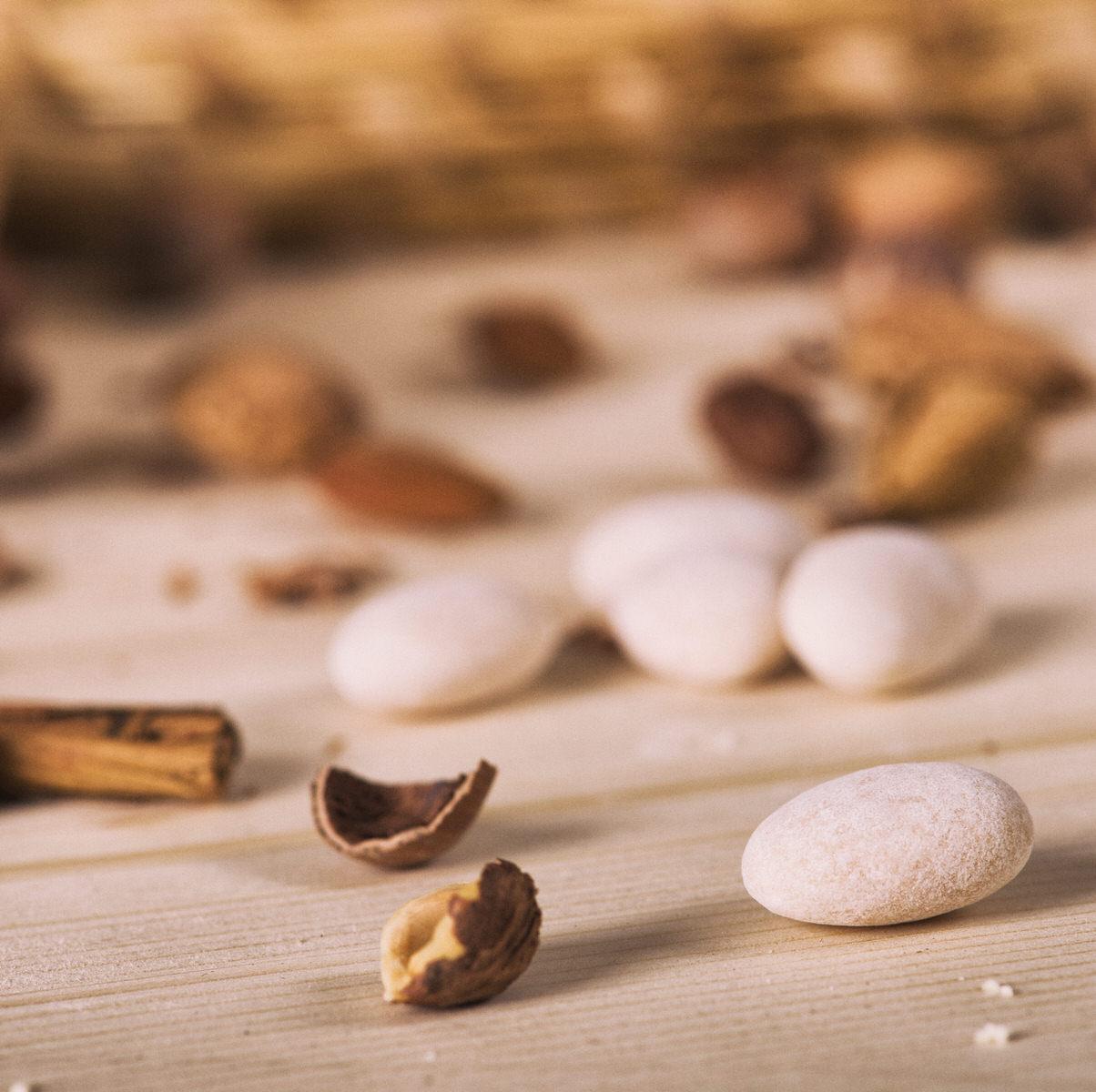
The origins of the confetto date back to ancient Rome. Historical sources attest to the use of sweets based on honey and flour, ancestors of sugar, during the celebrations of the Fabii family in 447 BC, and later in the writings of Apicius, a 1st-century AD gastronome and friend of Emperor Tiberius. The modern form of the confetto, the one with the sugar coating, was born however in the Renaissance era: sugar arrived in Europe through Arab mediation in the 12th century, but it became accessible to artisanal production only around the 15th century, when its cost began to fall.
It is precisely at this historical moment that Sulmona enters the history of confectionery. The first document preserved in the municipal archive attesting to the working of confetti in the city dates back to 1492–1493. The incubator for the tradition was the Monastery of Santa Chiara, where the Poor Clare nuns used silk threads to tie confetti into decorative compositions rosaries, ears of corn, bunches of grapes to give to noble newlyweds or on the occasion of religious celebrations. Thus was born, among the hands of cloistered nuns, what would become one of Italy's most characteristic artisanal crafts: the Fiori di Sulmona (Flowers of Sulmona), elaborate compositions of confetti wrapped in silk, tulle and satin, which still colour the shop windows of the historic centre today.
In subsequent centuries, production expanded beyond the convents and became the city's main economic axis. In the 17th century, Sulmona already hosted Venetian and Milanese merchants who settled there to trade confetti, so much so that in 1651 the Spanish viceroy was forced to issue a decree to regulate their activity. Two centuries later, in 1853, the historian Panfilo Serafini counted twelve active factories with about forty confetti makers, capable of producing one thousand pounds per day in various varieties: cannellini, pistachio, cocoa, almonds, strawberries. The English traveller Edward Lear, in his Illustrated Excursions in Italy of 1846, noted that confetti were "the great wealth of Sulmona".
The Sulmona confetto in its classic version is the result of three successive working phases, each indispensable to the final quality of the product. Everything begins with the selection of the almond, the ingredient that determines the flavour character of the confetto. The most prized varieties are the Pizzuta d'Avola, grown in the Syracuse area and protected by its Consortium, and the Fascionello, both appreciated for their shape and flavour. The Californian almond, although cheaper, is considered inferior in aromatic profile: its higher yield is due to irrigation, which dilutes its flavour.
The first phase is gommatura (gumming): the almond is coated with liquid gum arabic, a natural substance extracted from sub-Saharan acacia species, which acts as a primer and promotes the adhesion of subsequent layers. This is followed by incamiciatura (shirting), carried out with powdered rice starch an expensive ingredient and difficult to work with which gives the confetto its whiteness and surface uniformity. Producers who forgo rice starch obtain a confetto tending towards grey: this is not a secondary aesthetic detail, but an indicator of the quality of the workmanship.
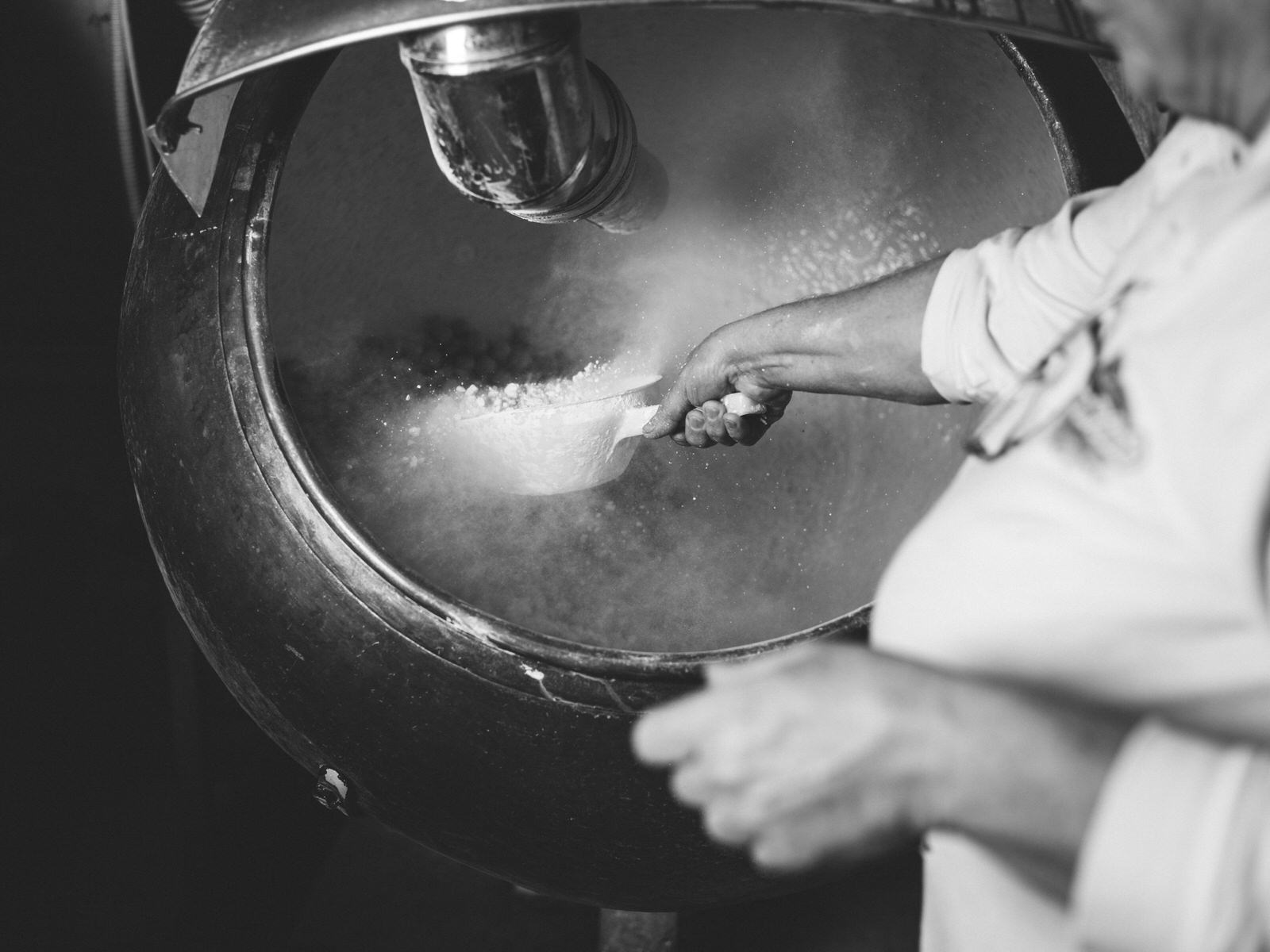
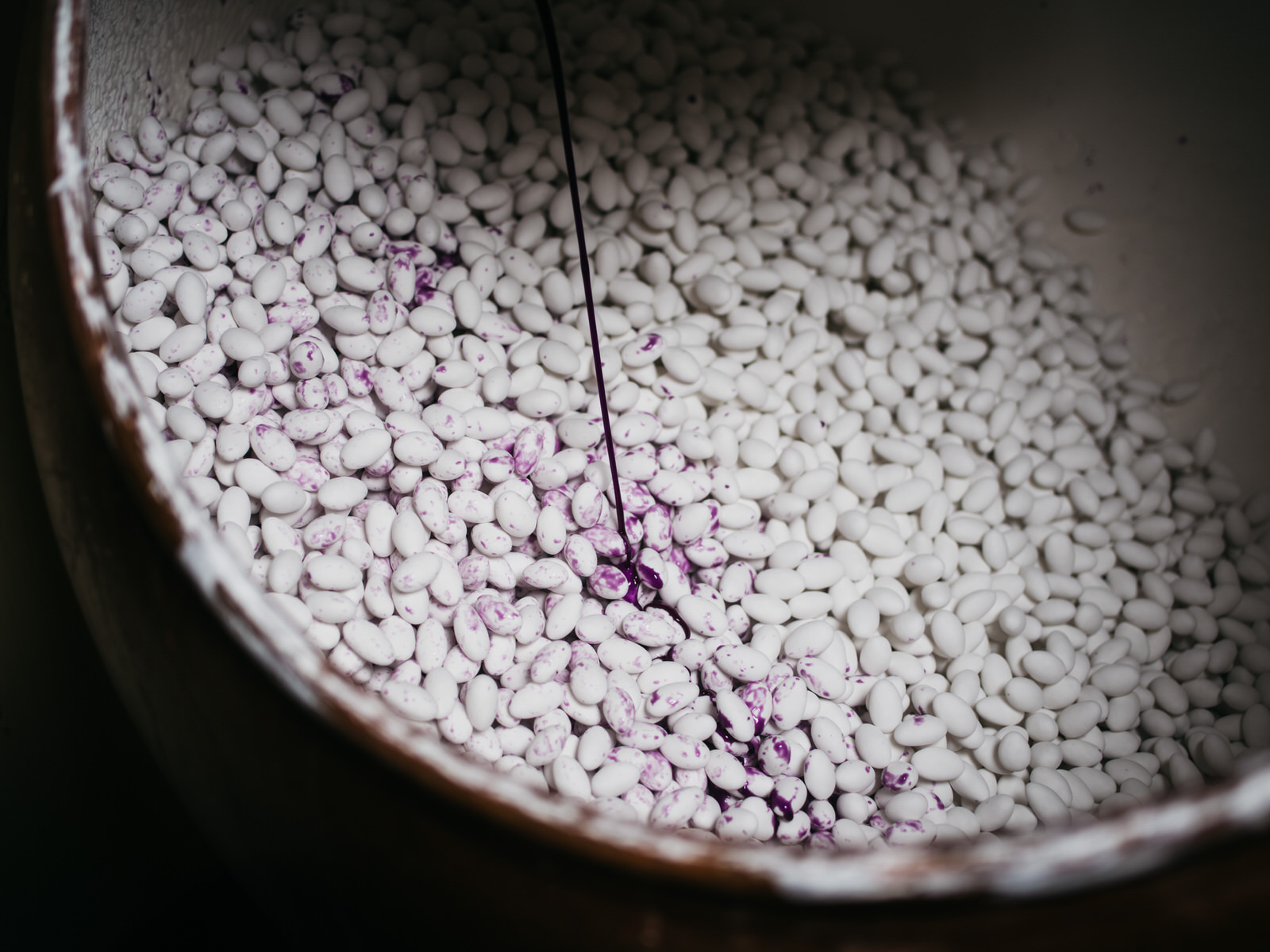
The third and longest phase is the actual confettatura (confett-making), carried out in bassine: rotating copper or steel cauldrons that spin the almonds while they are sprayed with sucrose syrup. Each cycle deposits a thin layer of sugar; the process is repeated several times until the desired thickness is reached. The quality of a confetto is also measured here: the thinner the sugar layer, the better the product less sweet, more soluble, more balanced in the proportion between coating and core. The empirical test of authenticity is simple: a true Sulmona confetto, immersed in a glass of water, dissolves completely without leaving residue. The presence of flour or lower quality starch would instead produce a visible deposit.
The term bassina, today used for modern steel pans, directly recalls pre-industrial craftsmanship: originally they were wide, shallow containers hung from the ceiling with ropes, manually swung by master confetti makers over a brazier. The physics of the process the rotary motion that distributes the sugar evenly has remained unchanged; the source of energy has changed, not the principle.
One of the most peculiar aspects of the Sulmona confectionery tradition is the symbolic system that governs colours and quantities. Each occasion has its colour: white for weddings, symbol of purity; pink for the birth of a girl, blue for a boy; red for graduation; green for engagement. The number of confetti in bomboniere (favours) is always odd three, five, at most seven and each number carries a specific wish. Five, the most common at weddings, represents happiness, health, fertility, wealth and longevity.
In the Peligna Valley, the sciarra still survives, a custom that involves throwing confetti and coins at the wedding or baptismal procession. The term, which in the Abruzzo dialect also indicates the concept of breakage and festive uproar, effectively describes the communal dimension of this gesture: the confetti do not belong only to the bride and groom, but to the entire community that acclaims them. The sciarra is documented in the dialect poem Zu matrimonio a z'uso by the Scanno poet Romualdo Parente (1765) and in numerous 19th-century folkloric testimonies.
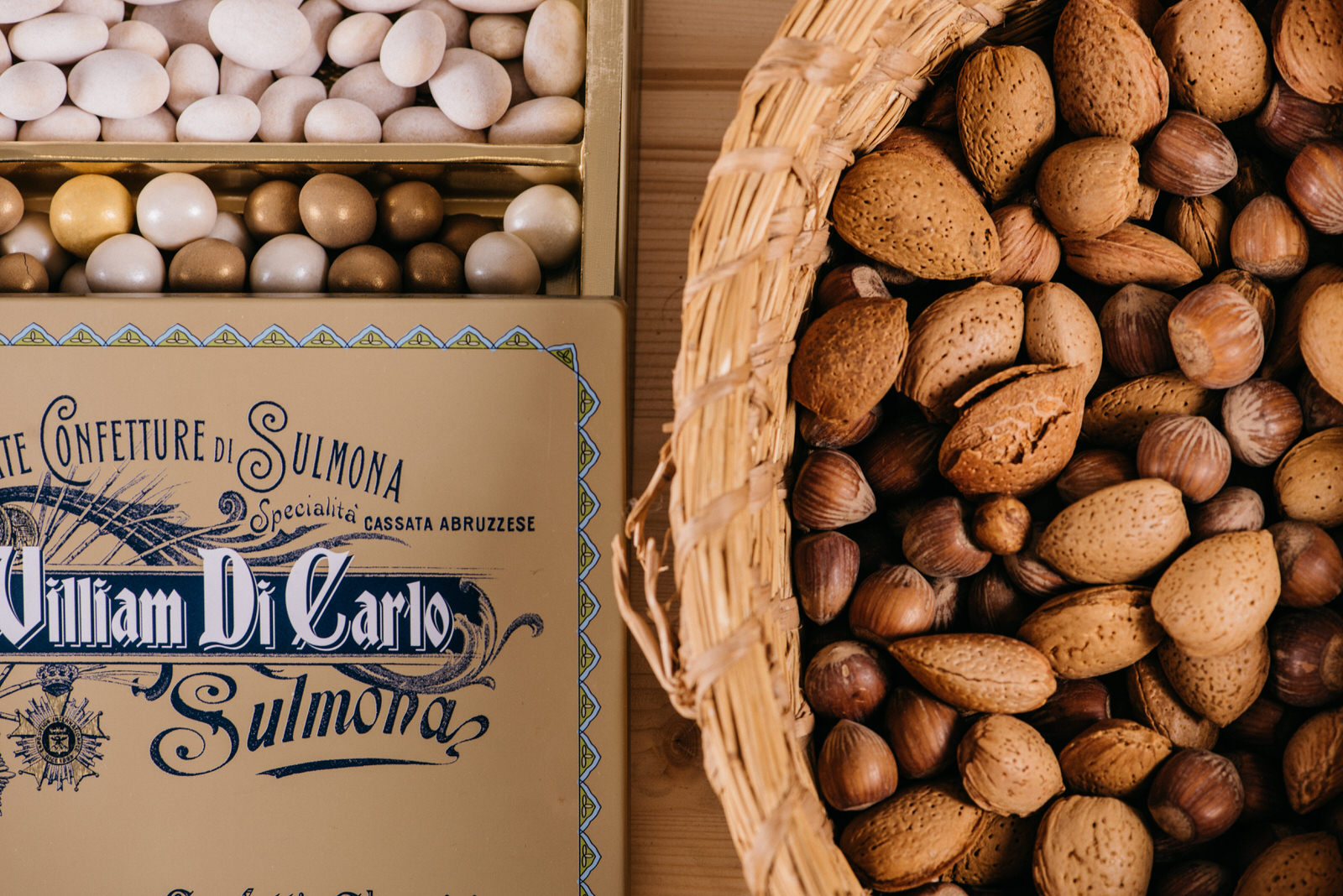
Among the realities that best embody this balance between memory and future is the Industrie Riunite Confetti William Di Carlo, founded in 1833 and today led by William Di Carlo junior, son of Italo. The company's history is intertwined with that of the city in a way that is unusual even for such an ancient tradition: it all begins in 1833 when Francesco Marcone, a confetti maker by trade, goes to the Sulmona registry office to register the birth of his son Filippo. From that moment, a productive genealogy begins that will cross family mergers, a world war, bombings, and finally an international relaunch that today brings Sulmona confetti to over twenty countries worldwide, from the United States to the United Arab Emirates, from Australia to Brazil.
An episode narrated in the company's history helps measure the artisanal stature achieved by the family over time: Achille Marcone, heir of the first generation, hosted King Umberto I of Savoy during a visit to Sulmona, looking after his reception and giving him a chocolate bust depicting his effigy. The King, struck by the welcome, wanted to give the family a diamond brooch, the image of which remained in the company logo until today. In 1925, Achille also created a reproduction in almond paste of Ovid's Metamorphoses to give to the sculptor Ettore Ferrari, author of the statue inaugurated in Piazza XX Settembre.
In 1999, the new Liberty-style factory along Viale del Lavoro, outside the historic centre, was inaugurated, which allowed for increased production capacity while maintaining the historic suppliers and the artisanal method unchanged. The generational change has not affected the philosophy: small and frequent productions to guarantee freshness, respect for the territory, natural ingredients, including colourings extracted from fruit and vegetables, and confetti certified gluten-free and present in the handbook of the Italian Celiac Association.
Questioned on the relationship between tradition and innovation, William Di Carlo junior described his vision thus: «To date we produce about 110 products, including confetti, confetti flowers, chocolate products, nougats. And among those created recently, the Cubano with rum, cinnamon and almonds, I believe it's the one that has given me the most satisfaction. It is born from the toasting of the almond, then coated in very fine white chocolate and enclosed in a very thin layer of sugar together with rum and cinnamon. A product that has a very strong identity» (statement given to Eleonora Lopes, Abruzzo Impresa, 18 July 2014). When asked what element represents for him the soul of the Sulmona confetto, the answer is consistent with the company's production philosophy: the quality of the almond and the purity of the sugar, with no compromises on additives or low-quality starches. A principle that holds true today as it did in 1833.
The Sulmona confetto is included in the list of Traditional Italian Agri-food Products drawn up by the Ministry of Agricultural Policies, a recognition that certifies its historical and productive value. But the true strength of this product is difficult to codify in regulations: it lies in the fact that Sulmona does not simply produce confetti, it inhabits them. The workshops of the historic centre including the historic Fabbrica Mario Pelino founded in 1783, the Bottega Rapone in the 15th-century palace in Piazza XX Settembre, and the Di Carlo shop—are not simple points of sale: they are places where production is still visible, narrated, transparent.
What distinguishes Sulmona from any other production centre is precisely this density: history is not archived in a museum, although the Museum of Confectionery Art and Technology at the Pelino Factory represents an extraordinary reference for anyone wishing to understand the technical evolution of this craft. History is alive in the hands of the confetti makers, in the copper bassine still in use, in the silk flowers that animate the shop windows of Corso Ovidio. In a city that bears in its coat of arms Ovid's verse, Sulmo mihi patria est, the confetto is perhaps the only artisanal production that still manages to live up to the myth.
Credit photos: I.R.C. WILLIAM DI CARLO

In 1291, Doge Pietro Gradenigo signed a decree that would forever change the history of European cra...

Tornano sabato 21 e domenica 22 marzo le Giornate FAI di Primavera, il più grande evento di pia...

2026 is approaching, and with the date set for Sunday, April 5th, the first real long weekend of spr...

Ever since 1946—the year of its birth—Vespa has always been synonymous with two concepts: revolution...

Squares have always been places where communities meet and recognise each other. Just think of the f...

Napoli, con la firma ufficiale della Targa d’Argento e la consegna delle bandiere, entra concre...
Rivista online registrata al Tribunale di Napoli n. 43 del 23/03/2022
Direttore: Lorenzo Crea
Editore: Visio Adv di Alessandro Scarfiglieri
Insight italia srl (concessionario esclusivo)
Rivista online registrata al Tribunale di Napoli n. 43 del 23/03/2022
Direttore: Lorenzo Crea
Editore: Visio Adv di Alessandro Scarfiglieri
Insight italia srl (concessionario esclusivo)
