
Autore: Michele Spinelli • 31/01/2026 08:41
Along the seaside promenades of Viareggio, in this Tuscan setting overlooking the Tyrrhenian Sea, one of Europe's most spectacular events comes to life every year. The Viareggio Carnival, reaching its 153rd edition in 2026, represents an unmissable appointment for those who wish to experience an event that fuses monumental art, sharp satire, and popular tradition.
The event has its roots in 1873 when a parade of carriages decorated with flowers travelled for the first time along the city's Via Regia. According to documented historical sources, that initiative was born from a group of young patrons of the Caffè del Regio Casinò, who decided to transform the Carnival from an elite celebration into a popular event capable of involving the entire community.
In 1883, the flower-decorated carriages were replaced by the first allegorical floats, made of wood, plaster, and jute by the artisans of the Viareggio shipyards. In 1905, the parades moved from Via Regia to the Passeggiata a mare, conquering a natural stage that still hosts the "Corsi Mascherati" (Masked Parades) today.
What makes the floats of the Viareggio Carnival unique is the papier-mâché technique, or more precisely, the moulded paper technique, perfected in 1925 by the Viareggio painter and builder Antonio D'Arliano. This innovation revolutionised the event, allowing the creation of increasingly imposing yet extraordinarily light structures.
The craftsmanship is based on a process that requires technical skills and artistic mastery. The material is made using tonnes of sheets of newspaper kneaded with a natural glue composed of water and flour. The procedure starts with creating a clay model, on which a plaster cast is made to obtain the negative mould. Strips of paper soaked in the mixture are applied inside the mould. Once detached, the work is smoothed with sandpaper and decorated with acrylic or tempera colours, protected by a glossy varnish.
Thanks to this technique, the master builders of Viareggio manage to shape allegorical floats that reach monumental dimensions: from 20 to 30 metres in height and 12 metres in width, with a weight that can reach 40 tonnes. These imposing self-propelled structures defy the laws of physics thanks to ingenious mechanical mechanisms that animate the figures with spectacular movements.
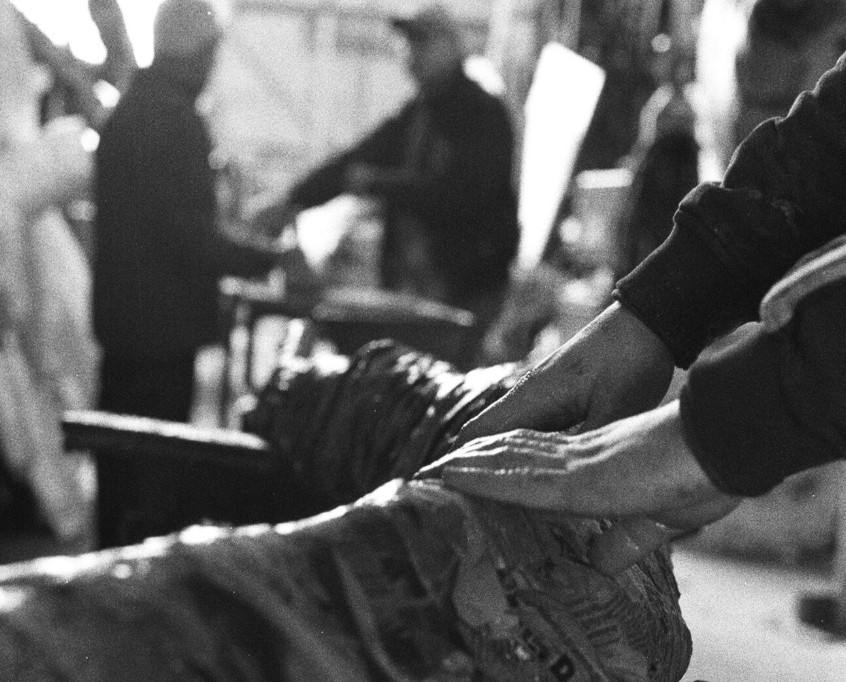
These paper giants are created by 21 artisan workshops that operate all year round in the Cittadella del Carnevale (Carnival Citadel), an extraordinary architectural complex inaugurated in 2001. This creative hub, located in the northern area of the city, comprises 16 hangars arranged around an elliptical square named after Burlamacco, the symbolic mask of the event.
The creative process begins during the summer when the master builders present their sketches to the Fondazione Carnevale for approval. From that moment, a race against time begins, lasting for months until the first parade in February.
The allegorical floats are famous worldwide for their ability to interpret, through satire and allegory, the great themes of contemporary life: from national and international politics to environmental issues, from social transformations to figures in the news.
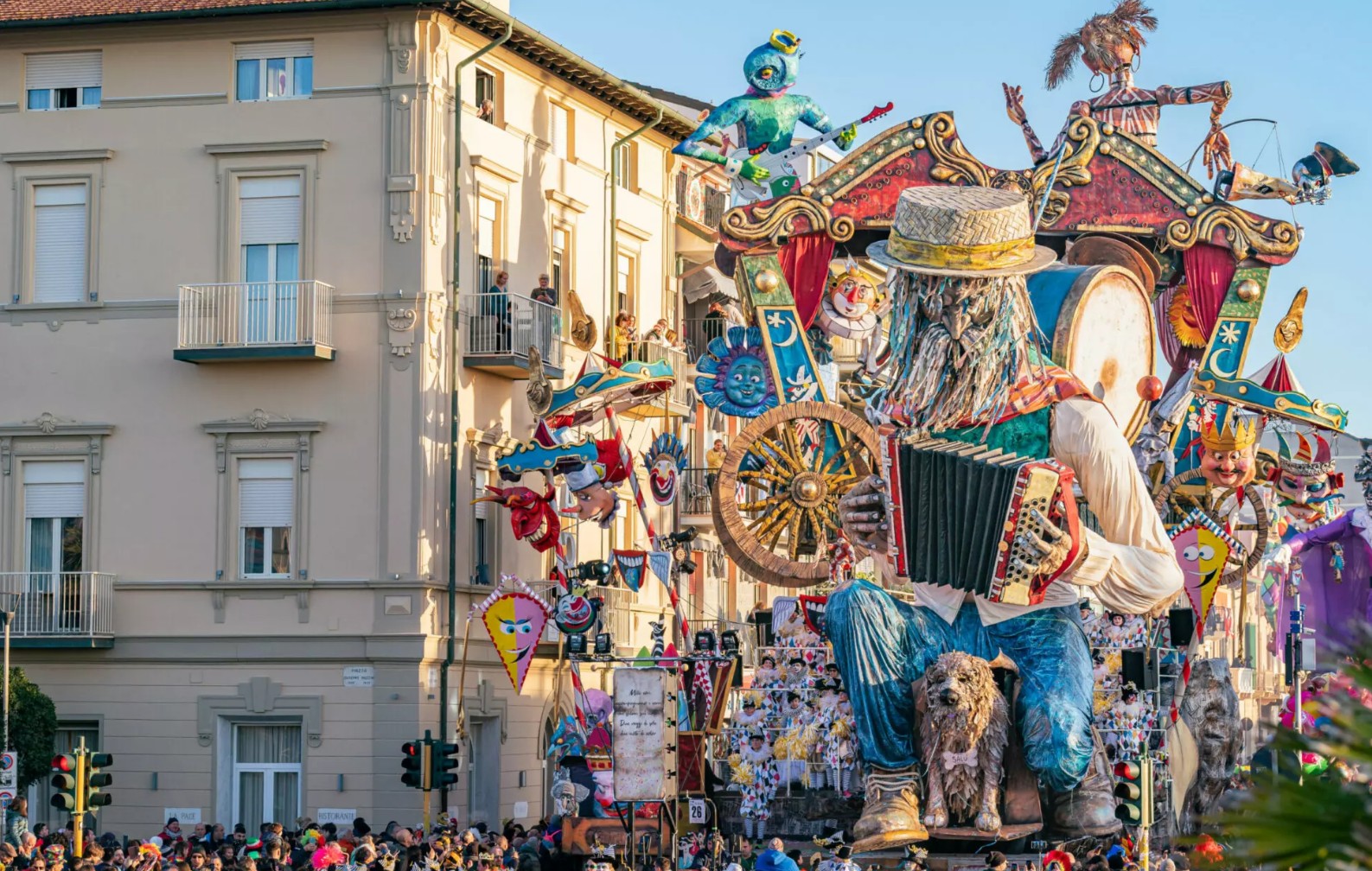
The Viareggio Carnival 2026 is structured into six Masked Parades distributed over the course of three weeks, from the 1st to the 21st of February. The official calendar states that on Sunday the 1st of February there will be the 1st Opening Masked Parade, with a fireworks display and much more. On Saturday the 7th of February at 17:00 there will be the 2nd Night Masked Parade, and on Thursday the 12th of February, Fat Thursday, the 3rd Night Masked Parade is scheduled, the highlight among the evening events, unmissable for the atmosphere and for anyone wishing to experience a magical Viareggio. On Sunday the 15th of February, Tuesday the 17th, and Saturday the 21st, there will be the final masked parades; the Saturday parade, as the closing event, will be the Night Closing Masked Parade and will proclaim the winner with magnificent and surprising fireworks displays.
Each parade represents a unique experience. The daytime parades allow one to admire the chromatic details and elaborate decorations of the constructions under the sunlight, while the night parades offer an even more suggestive spectacle, with the illuminated floats creating dreamlike scenery along the seafront.
This year, nine first-category floats and four second-category floats will parade, accompanied by group mascherate and isolated masks. On board each float, around 200 masked people find a place, singing and dancing for the entire duration of the parade.
The Viareggio Carnival is not limited to the Masked Parades. The event invades the entire city with a calendar rich in side events. The district festivals (*feste rionali*), born about thirty years ago, represent a fundamental moment in the Viareggio tradition. During these parties, organised in different neighbourhoods, the streets are closed to traffic and fill with music, food stands with local seafood specialities, and masks celebrating until late at night.
The programme also includes "Fuori Corso" (Off Course), a schedule of cultural appointments that this year explores the theme of colour. Exhibitions, performances, and meetings are concentrated mainly at the Museo del Carnevale, in the Cittadella.
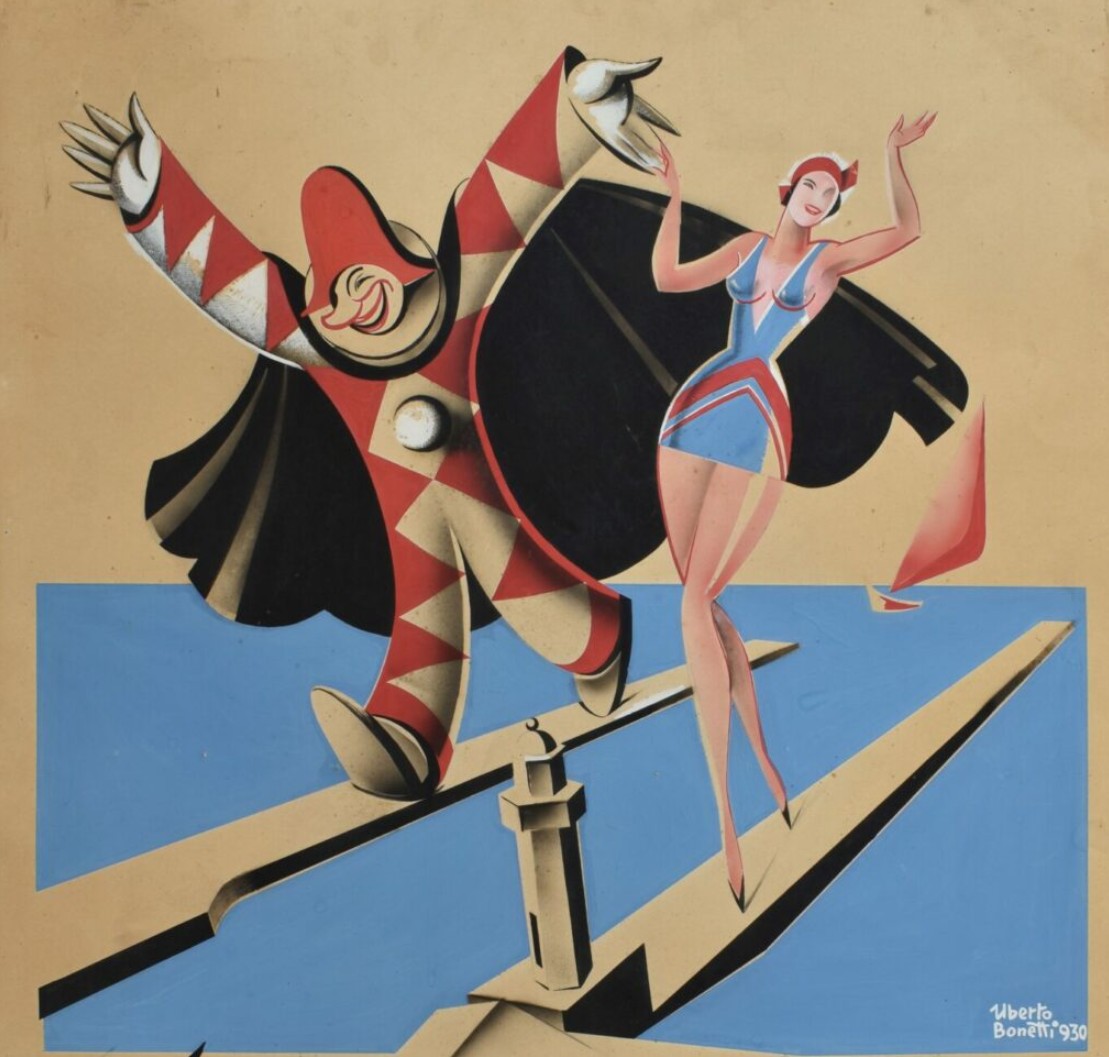
In 1931, a mask destined to become the symbol of the Viareggio Carnival made its first appearance on the official poster: Burlamacco, created by the Futurist painter and graphic artist from Viareggio, Uberto Bonetti. The character remained unnamed until 1939, when Bonetti revealed he had given it his own pseudonym, used when he signed cartoons for humour magazines.
The name alludes to several references: the Burlamacca, a canal that crosses the city; Buffalmacco, a Florentine painter of the 14th century who was the protagonist of some tales in the Decameron; and the Lucchese Burlamacchi family. The costume represents a Futurist synthesis of the main masks of the Commedia dell'Arte: the red-and-white checked jumpsuit recalls Arlecchino, the black cloak that of Dottor Balanzone, the pom-pom that of Pierrot, the hat that of Rugantino, and the white ruff that of Capitan Spaventa.
Alongside Burlamacco, Bonetti created Ondina, a female figure in a 1930s-style swimsuit symbolising summer and Viareggio's seaside vocation. In 1988, Burlamacco obtained official recognition by entering the Museum of Popular Arts and Traditions in Rome, consecrating itself as the last-born among the traditional masks of the Commedia dell'Arte.
For those wishing to deepen their knowledge of this tradition, the Carnival Citadel is an essential destination. This complex, freely accessible in its central square, houses the Museo del Carnevale, an exhibition space documenting the evolution of the event from 1873 to the present day.
The museum itinerary is structured on multiple levels. On the ground floor, a timeline presents artistic testimonies of Carnival in Europe from 1500 to 1873. On the first floor, the narrative focuses on the specific history of the Viareggio Carnival through scale models of floats, original sketches, and elements from historical constructions.
The layout includes the Espace Gilbert, which is enriched each year with new elements from the constructions that parade during Carnival. The space, as the name suggests, is dedicated to the Carnival artist Gilbert Lebigre and to all the masters of papier-mâché who have made the history of the Carnival.
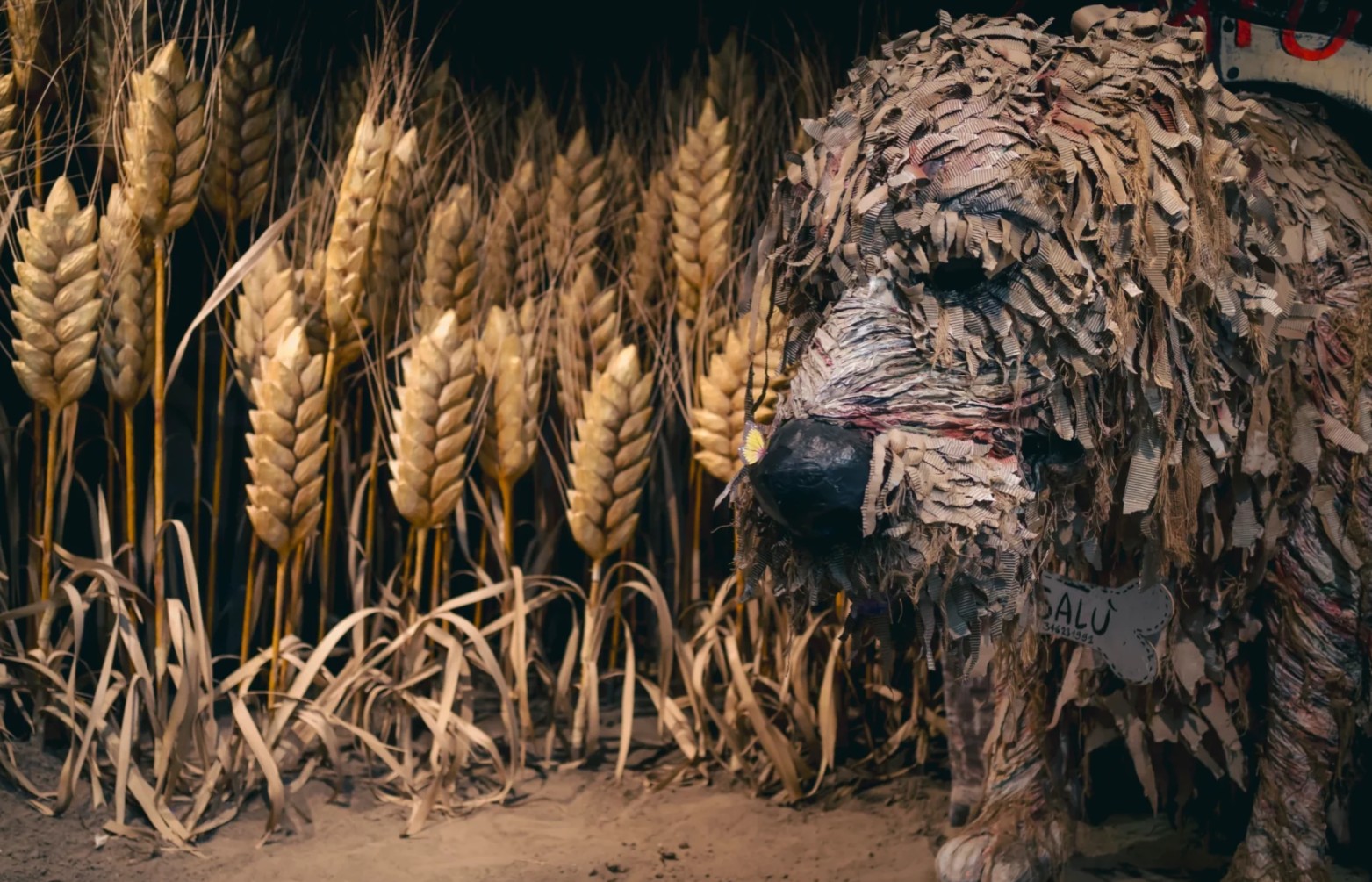
Welcoming the public is the gigantic ballerina created by Gilbert Lebigre, Corinne Roger, and Arnaldo Galli for the colossal and revolutionary float "Scusate se ci divertiamo, balla che ti passa" (Sorry if we're having fun, dance your troubles away), which won first prize in 2004. Around it, immersive stories in papier-mâché about art, fables, and nature unfold.
A must-see is the visit to the Carnevalotto Collection, housed in a permanent exhibition space reserved for the "Lorenzo Viani" Modern and Contemporary Art Gallery in Palazzo delle Muse on Piazza Mazzini, just a few metres from the Seafront Promenade. It gathers twenty-eight works from the Carnevalotto Prize, created by various artists and inspired by the Viareggio Carnival.
The journey to Viareggio is already a preview of the experience awaiting visitors. Those coming from Florence and the inland can take the A11 Firenze-Mare motorway, crossing the gentle hills of Montalbano and skirting Pistoia while admiring the profile of the Apuan Alps standing out on the horizon with their characteristic white marble quarries. From the north, the A12 Genoa-Livorno motorway offers panoramic glimpses of the Ligurian Sea, passing through the Cinque Terre area before descending towards Versilia. The recommended exit is the Viareggio Nord tollbooth.
Those travelling by car will find dedicated parking areas during the parades, with free high-frequency shuttles connecting the Cotone area to Piazza D'Azeglio, near the Masked Parades circuit. For campervan enthusiasts, the city offers equipped parking areas with complete services, allowing for a stay of several days to participate in different parades.
Those preferring public transport can use the urban network of Autolinee Toscane, which is reinforced during the event days. Line 21 connects the Carnival Citadel with the city centre.
The journey thus becomes an integral part of the experience: crossing medieval villages, admiring the marble mountains, and skirting the Tyrrhenian coast, visitors progressively enter the Tuscan atmosphere where art, natural beauty, and tradition merge in a unique balance.
The Viareggio Carnival represents much more than a popular festival. It is a cultural heritage that testifies to Italian artisanal creativity, the ability to combine art and social criticism, and the strength of a community that identifies with a shared tradition. According to 2025 data, the event recorded over 400,000 attendees, filling all the streets of Viareggio with music and art.
But beyond the numbers, what makes this Carnival special is its ability to renew itself while keeping its roots alive. Every year, the master builders tackle contemporary themes with innovative expressive languages, always respecting that artisanal technique perfected almost a century ago. The allegorical floats continue to be made entirely by hand, with a process requiring months of work and involving knowledge passed down from generation to generation.
The Viareggio Carnival 2026 presents itself as a unique opportunity to immerse oneself in a tradition that has crossed over a century and a half of history, evolving without ever losing its soul. Here, in this Versilian setting where the sea meets the monumental art of papier-mâché, satire meets beauty, and the popular festival elevates itself to a cultural heritage of international relevance. For those seeking an experience that goes beyond mere carnival fun, offering a deep insight into Italian creativity and the ability to use allegory to interpret the present, Viareggio represents an unmissable destination.
Credit photos: viareggio.ilcarnevale.com

Just over two months after the release of his latest critically acclaimed solo work, Louis Tomlinson...

“The Age of Cathedrals” Never Really Ended: Inside the Living Legacy of Notre Dame de ParisA Show Th...

“Troisi Poeta Massimo”: The Essential Return of Massimo Troisi, Thirty Years After The Postman’s Osc...

As spring approaches, just as it does every year, the Sigurtà Garden Park in Vialeggio sul Mincio is...

From 27 February to 28 June 2026, the elegant rooms of Palazzo Roverella in Rovigo will host the exh...

From 12 February to 14 June 2026, the splendid rooms of Palazzo Barberini in Rome will host the exhi...
Rivista online registrata al Tribunale di Napoli n. 43 del 23/03/2022
Direttore: Lorenzo Crea
Editore: Visio Adv di Alessandro Scarfiglieri
Insight italia srl (concessionario esclusivo)
Rivista online registrata al Tribunale di Napoli n. 43 del 23/03/2022
Direttore: Lorenzo Crea
Editore: Visio Adv di Alessandro Scarfiglieri
Insight italia srl (concessionario esclusivo)
