
Autore: Irene Pariota • 19/11/2025 18:40
Viterbo is a city full of surprises. Behind its perfectly preserved medieval walls lies a historical and artistic heritage spanning centuries, from the Etruscan presence to the memories of the long papal season of the 13th century. Despite the bombings of World War II, today its historic center is a harmonious mosaic of peperino stone, churches, noble palaces, fountains, and alleys where the past never seems to have truly passed. Here’s a small two‑day itinerary:
The discovery of Viterbo can only begin with its crown jewel: the medieval district of San Pellegrino, one of the largest and best preserved in Europe. Entering this maze of alleys means immersing yourself in another dimension: houses in rough stone, 13th‑century arches, flowered balconies, and the famous profferlo, the external staircase typical of Viterbo’s dwellings.
The small Piazza San Pellegrino is the heart of the district: here stand the church of the same name and the Palazzo degli Alessandri, spared from destruction thanks to Pope Innocent IV. Not far away, the Museum of the Sodalizio dei Facchini di Santa Rosa is worth a stop, telling the story of one of Italy’s most spectacular traditions: the Macchina di Santa Rosa, a canopy over 25 meters high carried on the shoulders of 100 porters on September 3rd, running through the streets of the center.
Heading toward Piazza della Morte, the landscape gradually changes. Spaces open up, historic shops, small squares, and cafés appear. Here, among austere facades and the ancient Fountain of San Tommaso, lies the entrance to Underground Viterbo: a network of tufa tunnels whose origins date back to the Etruscans and the Middle Ages. Walking through them means crossing centuries of hidden history, a fascinating journey of escape routes, secret passages, and strategic uses of the city over time.
From Piazza della Morte, in just a few minutes you reach Viterbo’s symbolic site: the Monumental Complex of the Colle del Duomo. Here, where the Etruscans founded the first settlement, stand the city’s three most iconic monuments: the Cathedral of San Lorenzo, the Colle del Duomo Museum, and above all the majestic Palazzo dei Papi.
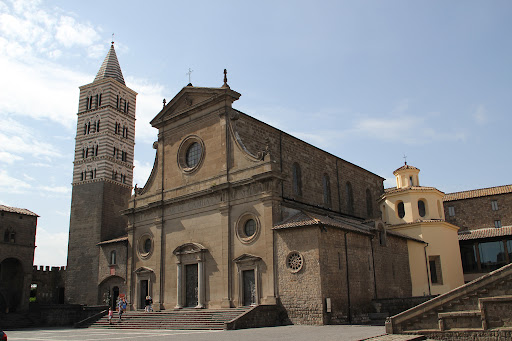
The Cathedral and the Museum The Romanesque and imposing Cathedral of San Lorenzo still preserves part of its 13th‑century cosmatesque floor and a medieval fresco depicting Saints Peter, Paul, and Lawrence. The church’s history is also the history of its wounds: the 1944 bombings struck it heavily, leaving behind a curious “double apse,” with the Baroque one hidden behind the Romanesque structure. Next door rises the small but rich Colle del Duomo Museum: Etruscan and Roman artifacts, medieval works, and sacred art treasures testify to the central role of the diocese.
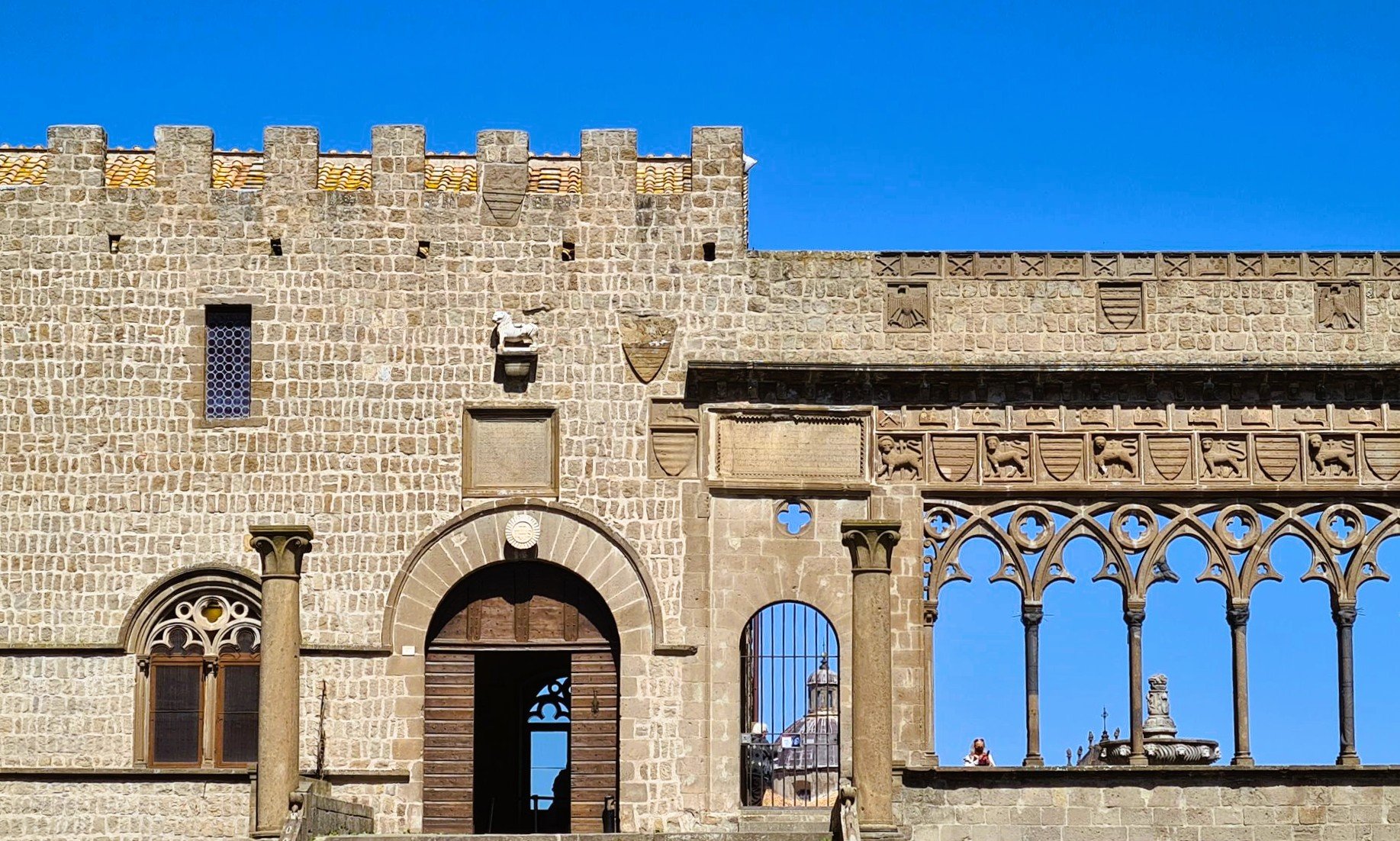
The Palazzo dei Papi and the longest conclave in history Built next to the cathedral, the Palazzo dei Papi dominates the square with its elegant Loggia of Blessings. It was here that one of the most famous episodes in Church history took place: the longest conclave ever, lasting 33 months (1268–1271). Unable to elect a new pope, the cardinals were locked in by the citizens of Viterbo, who even uncovered the roof of the hall to “let the Holy Spirit in.” Thus was born the term conclave (cum clave: “locked with a key”). Visiting the hall today, sober and bare, still conveys the power of that episode. With the Colle del Duomo, you can end the first day, perhaps with dinner in the medieval quarter, surrounded by the intimate, timeless atmosphere of its alleys.
The second day begins in the heart of the city: Piazza del Plebiscito, elegant and bright, dominated by the civic tower and the solemn Palazzo dei Priori, seat of the Town Hall. If the exterior may seem austere, the interior is a triumph of colors, decorations, and symbols.
The Palazzo dei Priori The visit takes you through five main rooms:
From here you can also visit the Museum of the Porticoes, which houses two works by Sebastiano del Piombo, including the splendid Pietà.
A few minutes’ walk brings you to the Church of the Gonfalone, a baroque marvel that leaves you speechless: the frescoed ceiling, designed for a trompe‑l’œil effect, seems to move as you approach the altar. It is one of Viterbo’s lesser‑known but most surprising treasures.
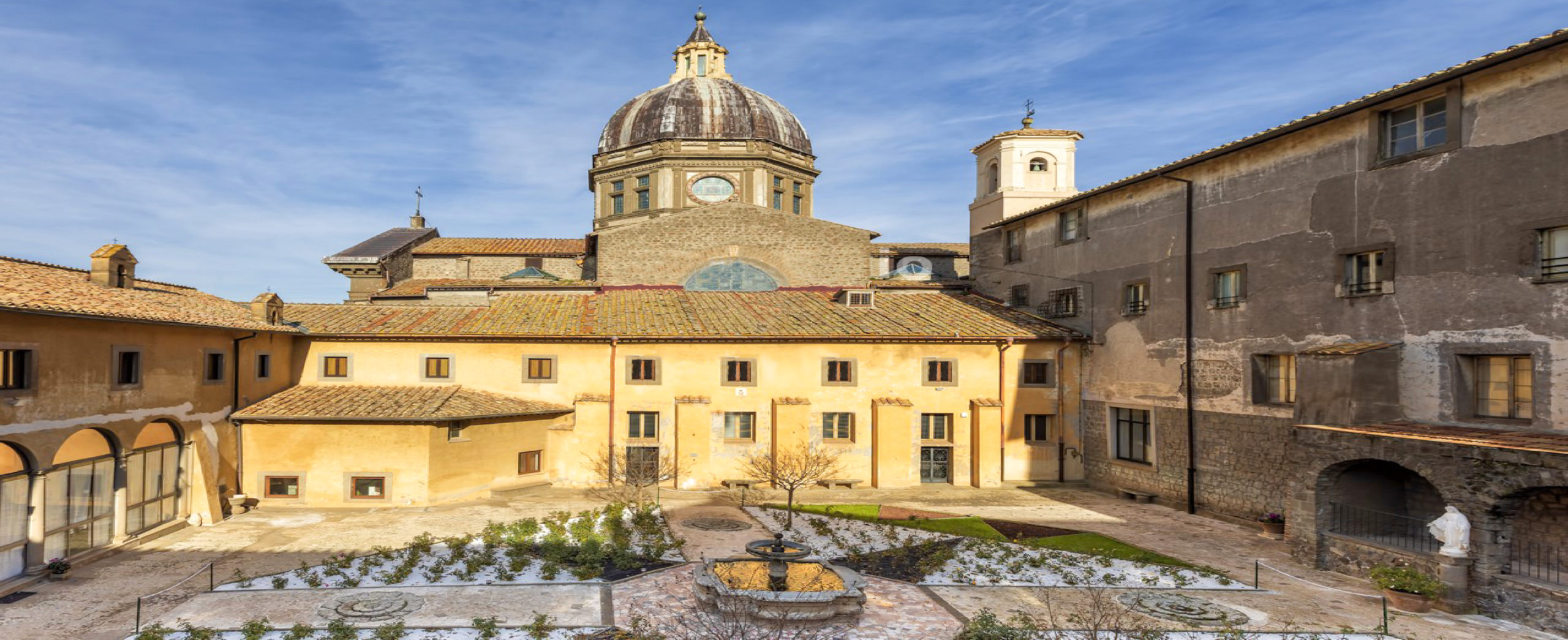
Church of Santa Rosa Continuing on, you reach the Church of Santa Rosa, with its adjoining convent and the saint’s birthplace. Here you breathe the city’s deepest identity, tied to its young patron and her feast. Miniatures of the Macchinecan again be found in the San Pellegrino museum, bearing witness to a tradition unique in Italy.
Other city treasures Art and history enthusiasts can continue to the Basilica of San Francesco alla Rocca, with the tombs of Clement IV and Adrian V, or reach the Complex of Santa Maria in Gradi, open on weekdays. Before leaving the center, a stop at Caffè Schenardi, a historic 19th‑century café on Corso Italia, is a true plunge into history: here figures such as Garibaldi, Marconi, and Pope Gregory XVI enjoyed a sweet or a coffee.
Relax at the free thermal baths The journey ends with one of the territory’s most famous treasures: the free thermal baths of Viterbo. Just 2.5 km from the center, the pools of Bullicame and the Carletti baths offer natural basins of hot sulfur water, immersed in the Tuscia countryside. From the time of the Etruscans and Romans to Dante’s verses, these waters have been celebrated for their benefits to skin, bones, and breathing. A perfect way to bid farewell to the city, wrapped in steam and the quiet of nature.
Two days are not enough to discover it all, but more than enough to fall in love with it—and above all, to understand why it is still called “the city of the Popes.”
Credit photo - Dove Viaggi, CDS

There is a sound that never fades. Not the kind that dissolves into the air, but that of bronze bell...

In small, middle-class Milan, near the Villaggio dei Giornalisti, temporary housing units were built...

We are in the early 1960s. On one side there is Enzo Ferrari, the "Drake", absolute monarch of the a...

From April 13 to 16, 2026, the Bologna Children’s Book Fair returns for its 63rd edition. Once again...

In 1291, Doge Pietro Gradenigo signed a decree that would forever change the history of European cra...

Tornano sabato 21 e domenica 22 marzo le Giornate FAI di Primavera, il più grande evento di pia...
Rivista online registrata al Tribunale di Napoli n. 43 del 23/03/2022
Direttore: Lorenzo Crea
Editore: Visio Adv di Alessandro Scarfiglieri
Insight italia srl (concessionario esclusivo)
Rivista online registrata al Tribunale di Napoli n. 43 del 23/03/2022
Direttore: Lorenzo Crea
Editore: Visio Adv di Alessandro Scarfiglieri
Insight italia srl (concessionario esclusivo)
