
Rivista online registrata al Tribunale di Napoli n. 43 del 23/03/2022
Direttore: Lorenzo Crea
Editore: Visio Adv di Alessandro Scarfiglieri
Insight italia srl (concessionario esclusivo)
Rivista online registrata al Tribunale di Napoli n. 43 del 23/03/2022
Direttore: Lorenzo Crea
Editore: Visio Adv di Alessandro Scarfiglieri
Insight italia srl (concessionario esclusivo)
Autore: Serena Trivelloni • 08/05/2026 11:18
Curated by Alessia La Scala, the Rome-based fashion and art event returns May 9 at the Salone delle Colonne, bringing together emerging designers, performance and a more immersive approach to the runway.
Roma Eterea is stepping into its second edition with the confidence of an event ready to define its own language. Returning May 9, the Rome-based project once again places fashion in conversation with art, performance and contemporary culture, but this time with a renewed setting, a more expansive creative direction and Alessio Filippelli as host.
Following its 2025 debut at Spazio Novecento, where the event introduced itself as a platform for emerging creativity, sartorial research and new expressions of contemporary fashion, Roma Eterea now moves to the Salone delle Colonne, in the heart of Rome’s EUR district. The change of venue is more than a logistical shift. It signals a new phase for the event: more atmospheric, more immersive and more consciously constructed around the relationship between audience, space and runway.
At its core, Roma Eterea remains faithful to the idea that fashion is not only something to be shown, but something to be experienced. The second edition will bring together designers with distinct aesthetics and creative identities, including FrAnge Couture, the label founded by Angela Gandolfi and Francesca Cellini; Bernadet Zalewska; Benedetta Graziani; Focus DressCore by Elena Pandolfi; Pietro Monterosso; and 22 Designer by Sara Limone.
The evening will also feature “Velvet Flow,” a contemporary dance performance created exclusively for Roma Eterea by international choreographer Cristina Pitrelli and performed by dancer Asia Beccafico. Conceived as an artistic intervention within the event, the performance reinforces one of Roma Eterea’s central ideas: fashion as movement, body, rhythm and narrative.
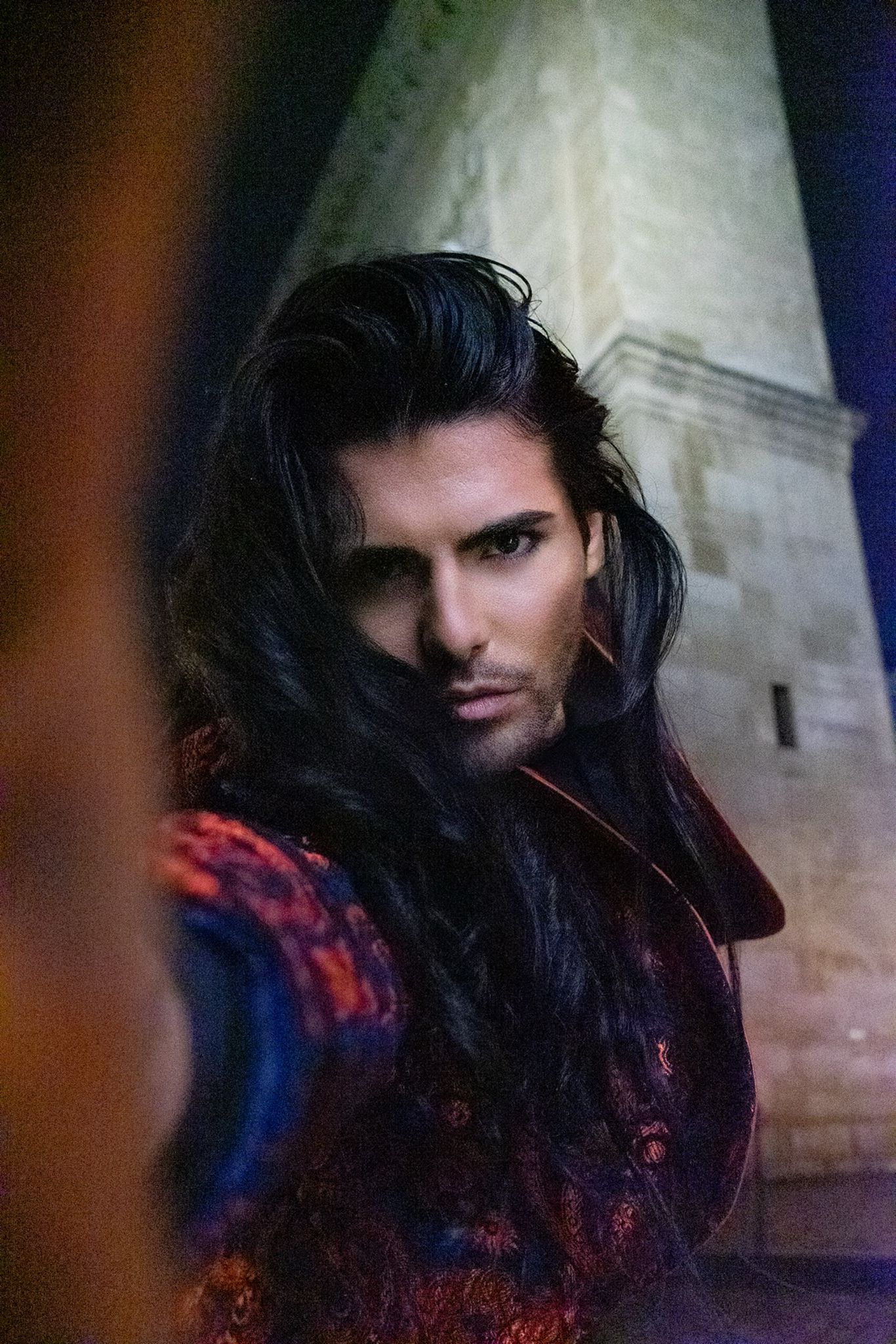
Behind the project is Alessia La Scala, the organizational and creative force behind Roma Eterea, who has shaped the event across every level: from artistic direction and designer selection to models, staging and location. For this edition, La Scala worked alongside Alessio Filippelli, contributing to a broader creative direction that aims to transform the evening from a traditional runway format into a more layered, immersive experience.
Filippelli, a fashion and entertainment manager, is one of the defining additions to this new edition. As host, he is not simply being asked to present the evening, but to guide its rhythm and shape its relationship with the audience.
“Presenting Roma Eterea has a special meaning for me,” Filippelli said. “It is curious to think about how certain paths come together: an event is born, grows, evolves, and you find yourself inside it precisely at the moment when it can change its skin. Even though this is already its second edition, I strongly feel the energy of a ‘first time’: the first time I tell its story, the first time I can interpret it through my own language.”
That language is rooted in his long-standing relationship with fashion, a world he describes not as surface, but as structure and communication.
“Those who know me know that, for me, fashion has never been only about aesthetics,” he said. “It is vision, construction, rhythm. It is a way of communicating, a message or a movement. That is why I am truly happy to present an event of this scale, because it is not simply about being on a stage, but about giving shape to an experience.”
For Filippelli, the idea of experience is central. This year’s Roma Eterea will not unfold as a distant, linear presentation, but as a more fluid exchange with the audience.
“My hosting will not be a simple linear narration, but a continuous dialogue,” he said. “More interaction, more involvement, less distance. I want those attending to feel part of something that is happening, not spectators of something that merely passes before them.”
His role has extended beyond the stage. In recent months, Filippelli has worked with Alessia La Scala and the Roma Eterea team on the creative direction of the event, helping rethink its pace, structure and energy.
“That made the difference,” he said. “I was not interested only in telling the event, but in helping build it. We rethought dynamics, rhythm and energy. We made everything more alive, more dynamic, more consistent with an idea of fashion that is not static, but in motion.”
It is this sense of motion that defines the second edition. Roma Eterea is positioning itself not only as a showcase, but as a space of encounter: between designers and audience, fashion and performance, aesthetic research and contemporary vision. It is designed for those who love fashion, but even more for those who live it, who observe it, interpret it and question it.
“Roma Eterea, in this edition, is exactly that,” Filippelli said. “An event for those who love fashion, but above all for those who live it. For those who observe it, interpret it, question it. It is not just a showcase. It is an inclusive space open to everyone.”
As it approaches its second edition, Roma Eterea appears increasingly intent on carving out a recognizable place within Rome’s fashion landscape. Its ambition is not simply to present collections, but to expand the perimeter of the runway, turning fashion into atmosphere, dialogue, performance and participation.

There's a phrase that perfectly sums up the spirit of Eufonica 2026, and it's worth starting there: ...

Curated by Alessia La Scala, the Rome-based fashion and art event returns May 9 at the Salone delle ...

Dal 2 maggio al 2 giugno torna uno degli appuntamenti più attesi della primavera partenopea: la 32ª ...

Ten years after his death, Ettore Scola returns to the spotlight at the Museum of Rome at Palazzo Br...

“The Age of Cathedrals” Never Really Ended: Inside the Living Legacy of Notre Dame de ParisA Show Th...

From 27 February to 28 June 2026, the elegant rooms of Palazzo Roverella in Rovigo will host the exh...
