
Autore: Luigi Graziano Di Matteo • 01/08/2025 08:09
The past few years have been a time of great splendor for the city of Naples—thanks to SSC Napoli’s two league titles, the rediscovery of its neighborhoods, and the success of the many concerts hosted in the city. More and more tourists visit Naples and are amazed by the beauty of its metro stations.
Before we reach the present day, though, let’s travel back to the 1990s.
In March 1993, the first section of Naples’ hillside metro was inaugurated, linking Colli Aminei to Vanvitelli.
Since then, many more stations have opened, improving connections between Naples’ neighborhoods, the northern outskirts, and national transport hubs such as Napoli Centrale, the port, and soon the Capodichino International Airport.
Let’s now discover the stations which—beyond being strategic nodes—house extraordinary artworks that turn them into station-museums.
Along Line 1 and Line 6, numerous stations lend themselves to photography and, in some cases, even film sets.
From Rione Alto, the beating heart of the hospital district, to Centro Direzionale, a strategic axis hosting the courthouse, an interchange with FS and EAV, and the city’s economic-financial hub, these stations hold true treasures of art.
Line 6 stations—opened only recently—have also earned several international accolades.
Our journey among the gems of the Naples metro begins at Quattro Giornate.

The Quattro Giornate station (formerly Cilea) has an engineering and architectural feature that makes it unique: its platforms are set on two different levels.
Opened in 2001 and completed with the contribution of architect Domenico Orlacchio, the station hosts numerous installations, many of which celebrate the remarkable resistance of Neapolitans during the Four Days of Naples. Among them is Marisa Albanese’s Combattenti, a painted bronze and steel sculpture depicting four seated female figures inspired by the women of the Resistance. (Ph. F. Donato)
We continue to Salvator Rosa. You might expect to arrive here by train—but what will surprise you inside are four Fiat 500s. How did they get there? Of course, they’re part of yet another artwork enchanting visitors.
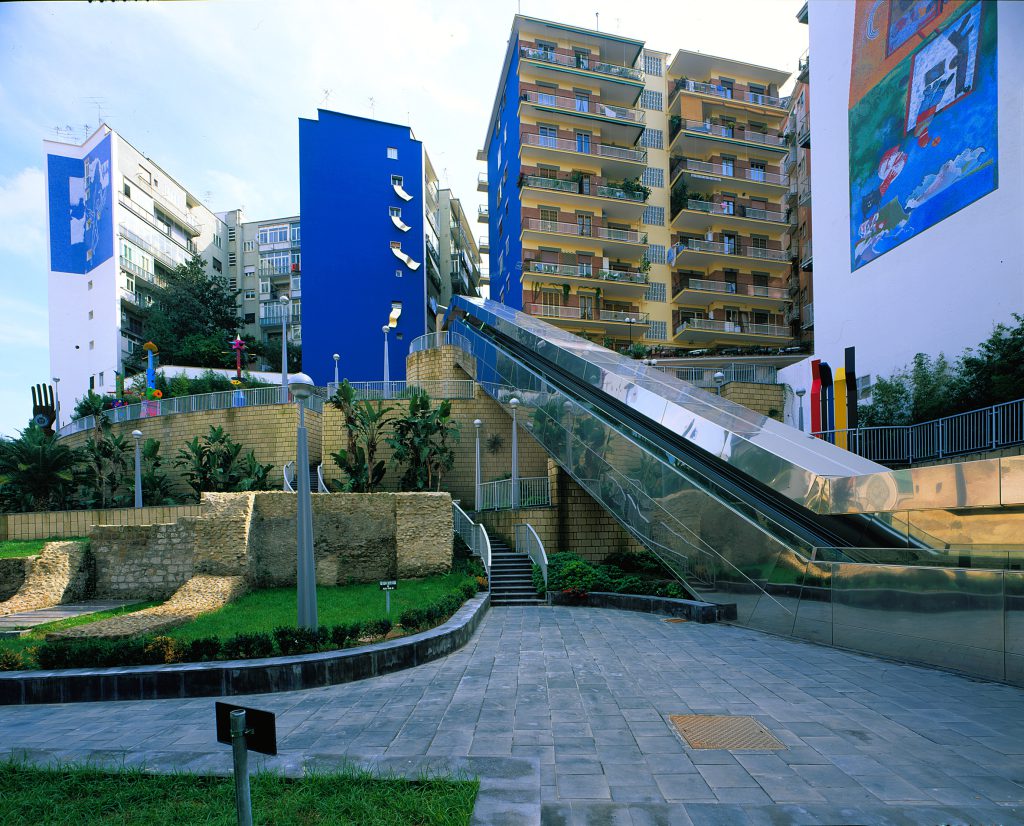
The station’s outdoor areas were also extensively redeveloped, restoring the remains of a Roman bridge and a charming neoclassical chapel; nearby buildings were similarly transformed into works of art.
The piece, titled “’A Subway è chiù sicura” by Emiliano Perino and Luca Vele, delivers a clear message: the metro is safer and more eco-friendly than cars.
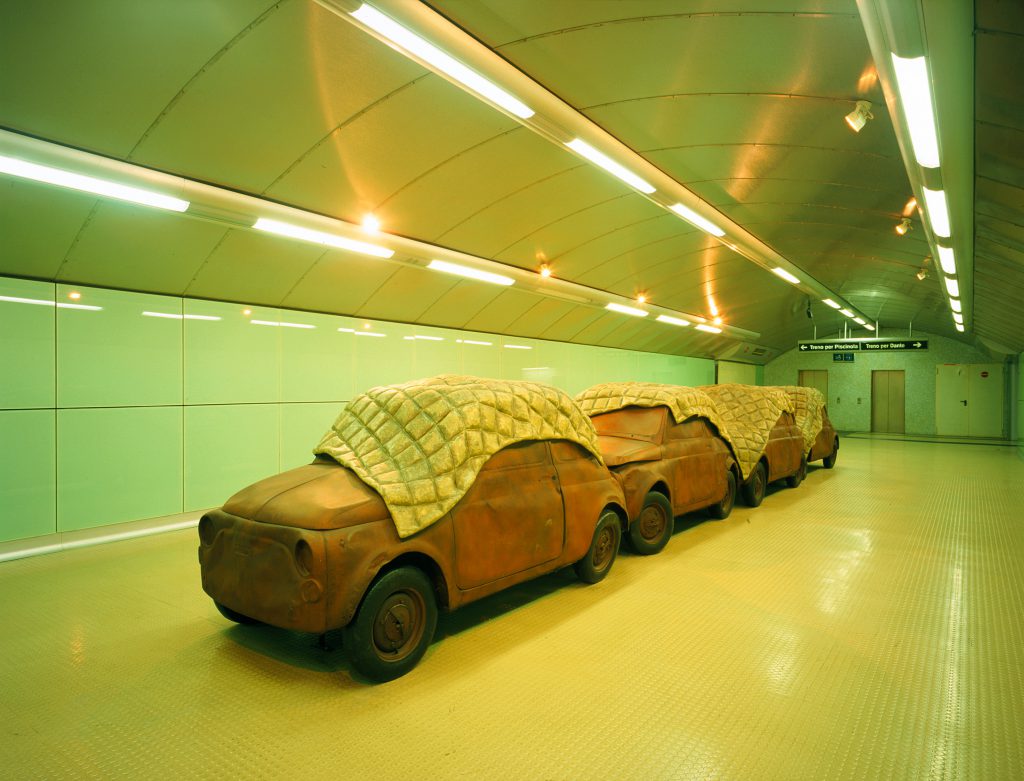
(Ph. Luciano Romano)
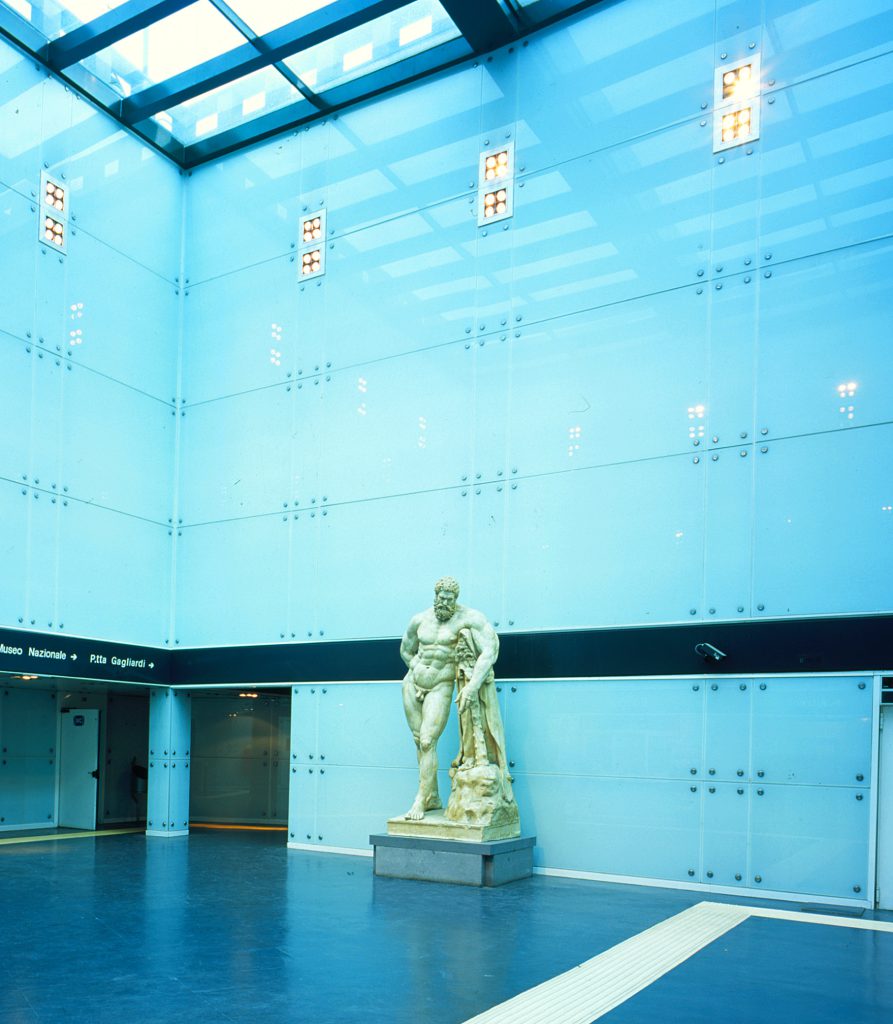
Designed by Gae Aulenti and opened in 2001, Museo faithfully echoes the masterpieces of the adjacent National Archaeological Museum.
Inside are replicas of the Farnese Hercules, the bronze cast of the Carafa horse’s head, and a fiberglass statue created by the Academy of Fine Arts.
The Farnese Hercules, greeting travelers in the concourse, represents the hero at the end of his first labor, after slaying the Nemean lion, and holding in his right hand the three golden apples stolen from the Garden of the Hesperides.
A photo gallery in the passageway to Line 2 features prints by Biasucci, D’Alessandro, Donato, and Mariniello. (Ph. P. Avallone)
Named after the Supreme Poet, Dante was designed by Gae Aulenti and inaugurated in 2002. It sits at the center of the square of the same name, which Aulenti also redesigned.
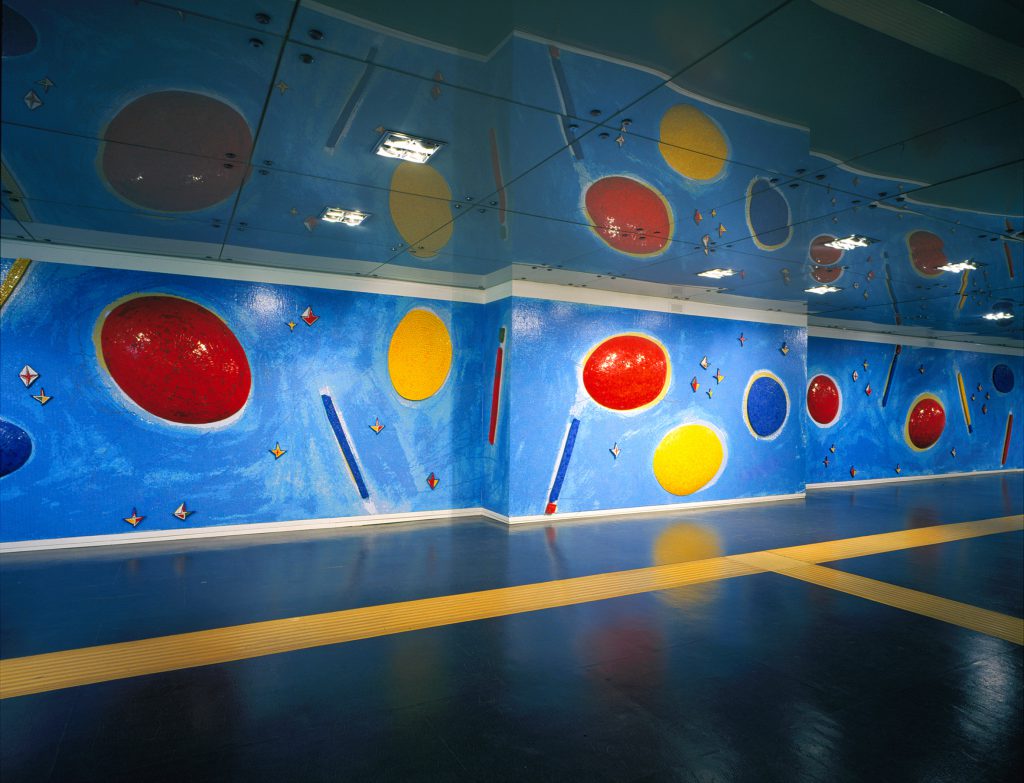
Its interiors showcase works by leading figures of international contemporary art, including Joseph Kosuth, Jannis Kounellis, Nicola De Maria, and others.
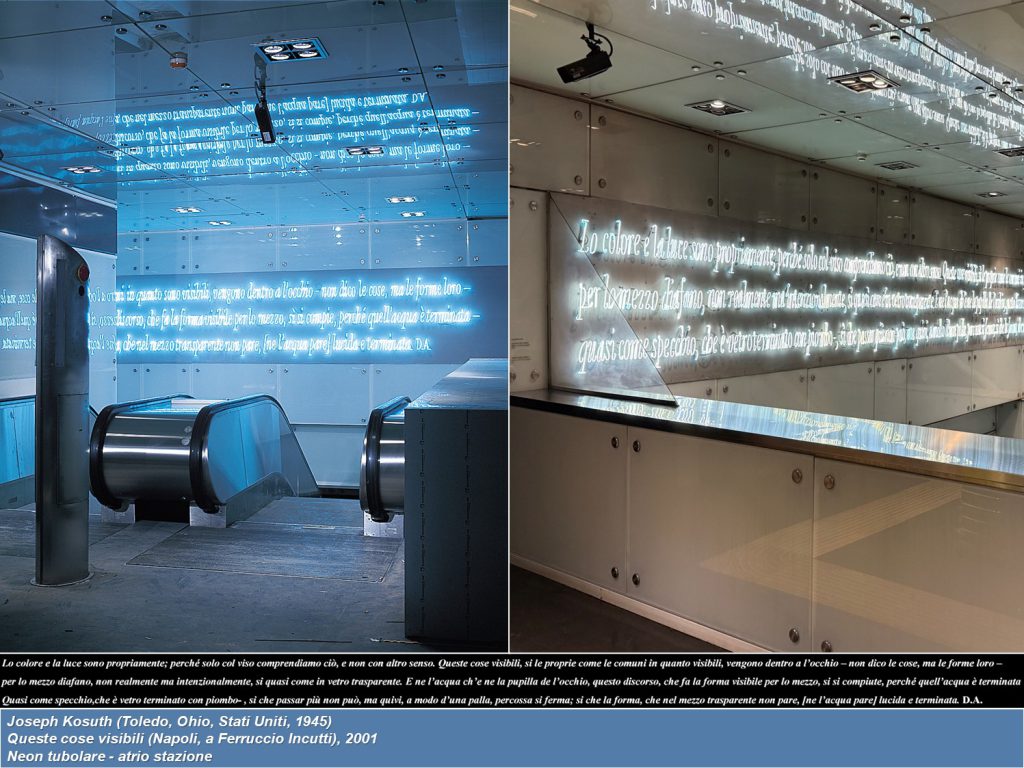
Among the most notable pieces is “Queste cose visibili”—a white neon work by Kosuth drawing on a passage from the Convivio about visual perception. Also noteworthy is Nicola De Maria’s mosaic “Universo senza bombe, regno dei fiori, 7 angeli rossi,” dedicated to his father Francesco and expressing an art that embraces the happiness of all living beings. (Ph. P. Avallone)
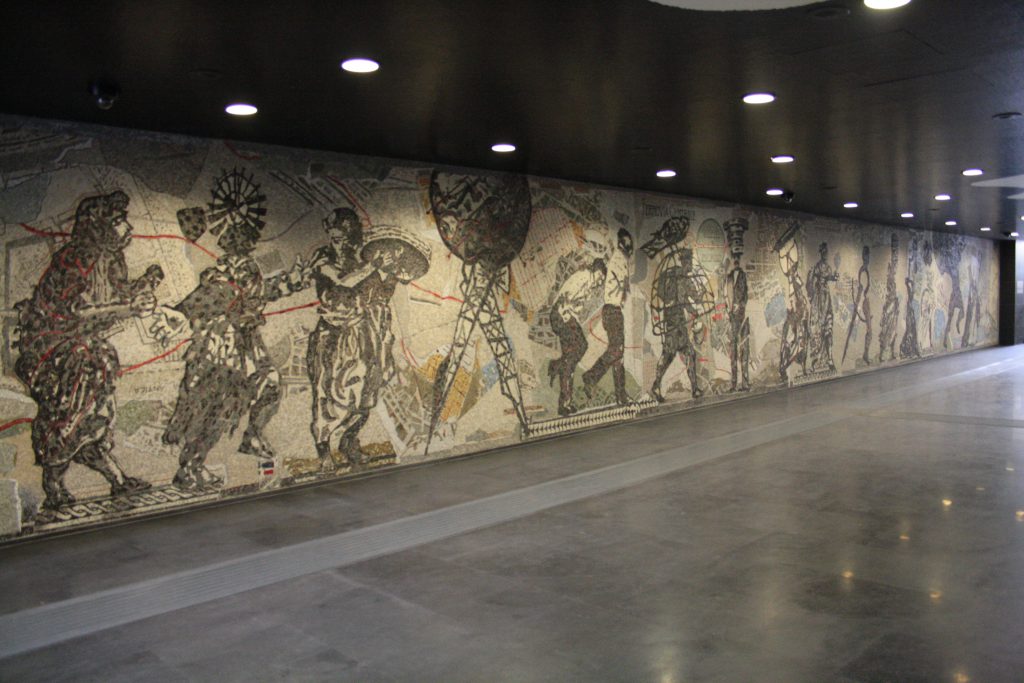
Designed by Oscar Tusquets Blanca and located along bustling Via Toledo near the Spanish Quarters, Toledo immediately captivates with William Kentridge’s mosaic depicting a procession led by San Gennaro, using figures drawn from the city’s history. (© ANM)
Descending toward the platforms, you encounter Tusquets’ stunning Crater de Luz, a light well that descends from street level to a “submerged hall” 40 meters below ground. Robert Wilson later enriched it with 144 full-color LEDs, creating evocative light scenes. The grand hall’s walls are clad with metallic waves—Tusquets’ Olas.
Along the corridor linking the platforms with the Montecalvario exit, two long LED lightboxes reproduce the image of a gently rippling sea. (Ph. P. Avallone)
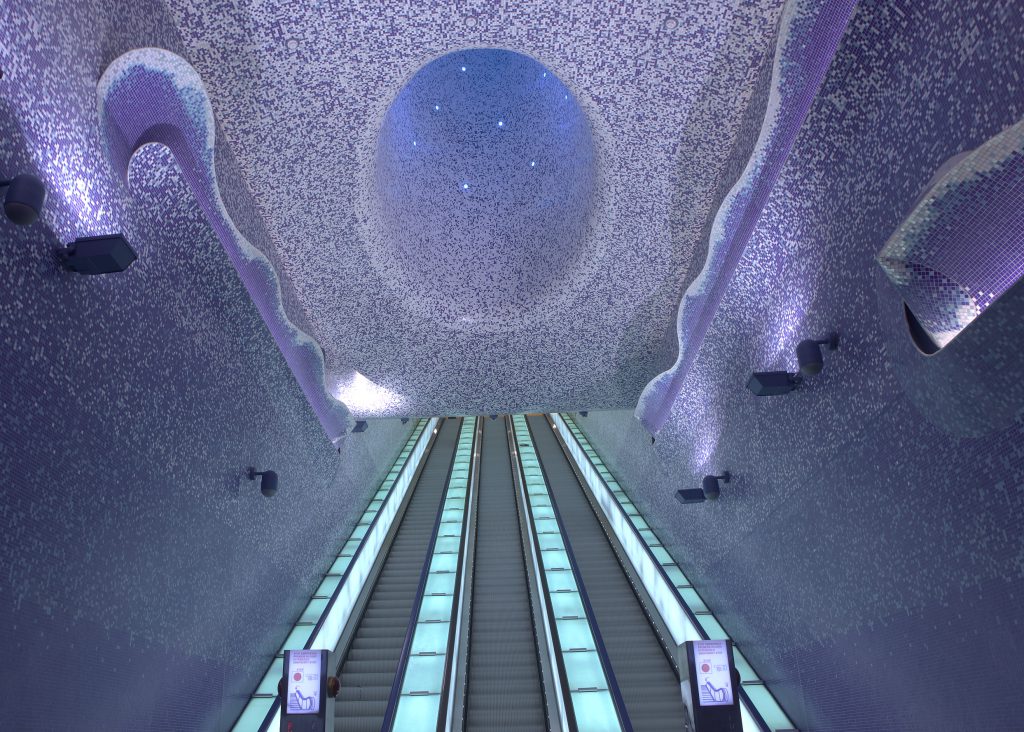
These extraordinary installations have earned Toledo and ANM numerous international honors, including:
• Named by the Daily Telegraph on Dec 3, 2012 as the most beautiful station in Europe;
• LEAF Awards (London, Sept 2013), Transport & Infrastructure category;
• LEAF Interior Design Awards (Berlin, Oct 18, 2013);
• Nominations at PLDR Award Gala Dinner 2013 (Copenhagen): Best Daylighting Project and Best Natural Lighting Project;
• Listed in 2014 among the world’s most beautiful stations by CNN.
Municipio is one of Line 1’s principal strategic gateways and also the Line 6 terminus (reopened in 2024) linking it to Mostra.
Designed by Alvaro Siza and Eduardo Souto de Moura, the station is in Piazza Municipio, the seat of city hall.
Nicknamed “The Gateway to the Sea,” it connects to the Port of Naples via a 225-meter pedestrian tunnel opened on July 10, 2023. At the end of the tunnel lie the remains of the Angevin pier, recovered during construction. Excavations unearthed a vast trove of archaeological finds.
The final design includes a major museum space to conserve and showcase most of these artifacts after careful restoration.
Its proximity to Castel Nuovo led to the discovery of Angevin and Aragonese walls—such as the Torrioni del Molo and dell’Incoronata—visible within the station’s base.
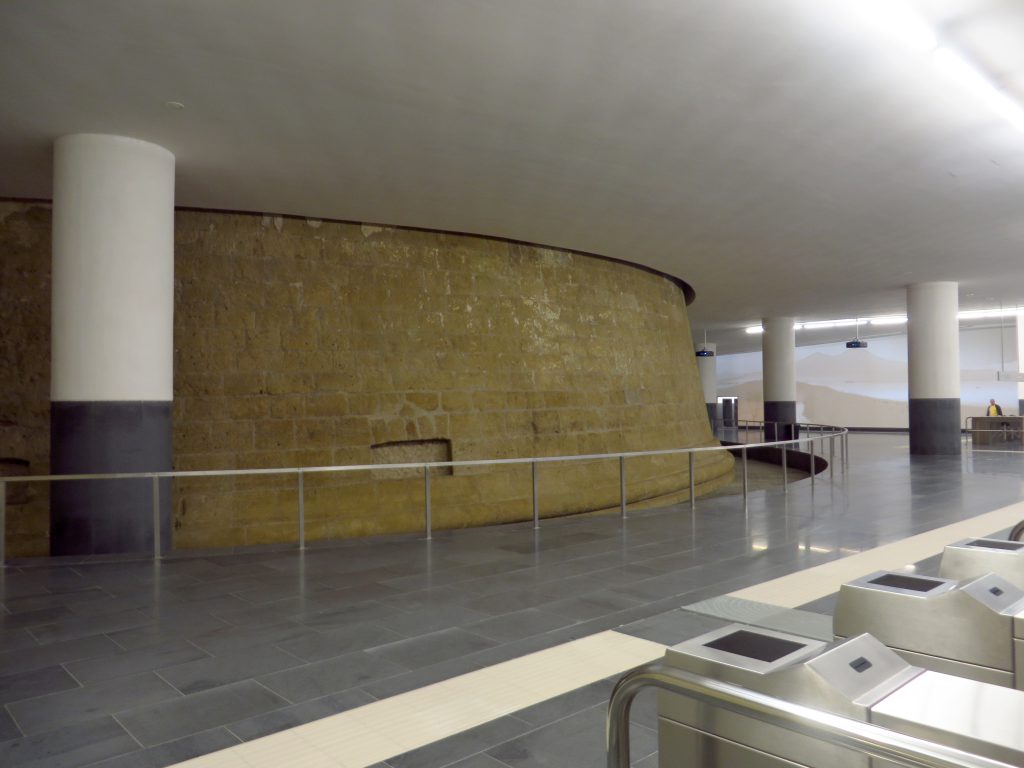
Urban redevelopment of the square restored the Fountain of Neptune and created a two-level pedestrian plaza; a long, tree-lined opening naturally lights the underground corridor to the port.
The station’s minimalist design nods to modernism, with finishes in lava stone, brick, and plastered surfaces.
In 2014, Michal Rovner created the video installation Passages on the continuous flow of travelers, while Mimmo Jodice installed seven photographs dialoguing with the excavated artifacts. (© ANM)
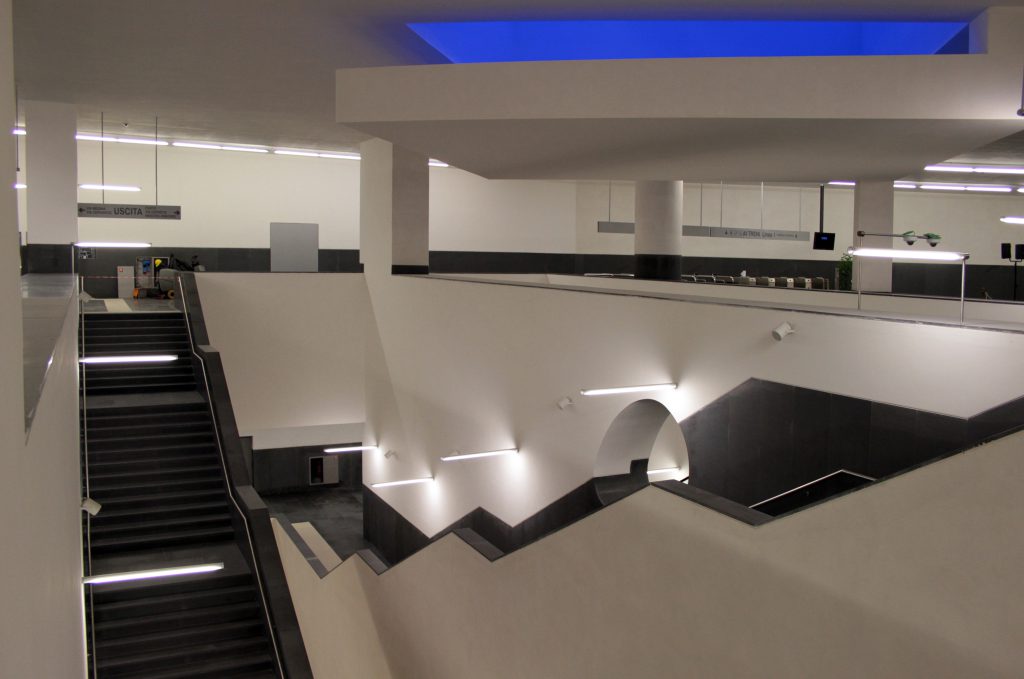

Designed by Karim Rashid and located near Piazza Borsa and the main campus of Università degli Studi di Napoli Federico II, Università won the Emirates LEAF International Award in 2011 (London). Excavations revealed significant finds: an urban block active from the 12th–19th centuries, a Roman coastal basin with an artisanal quarter (6th century), and a Byzantine fortification.
Rashid conceived the interiors as a sensory journey: at ticketing level, the Conversational profile pillars (2010) depict emblematic faces of human dialogue, while Synapsi (2010)—an aluminum sculpture crafted by Corrado Tamborra—represents neural connections.
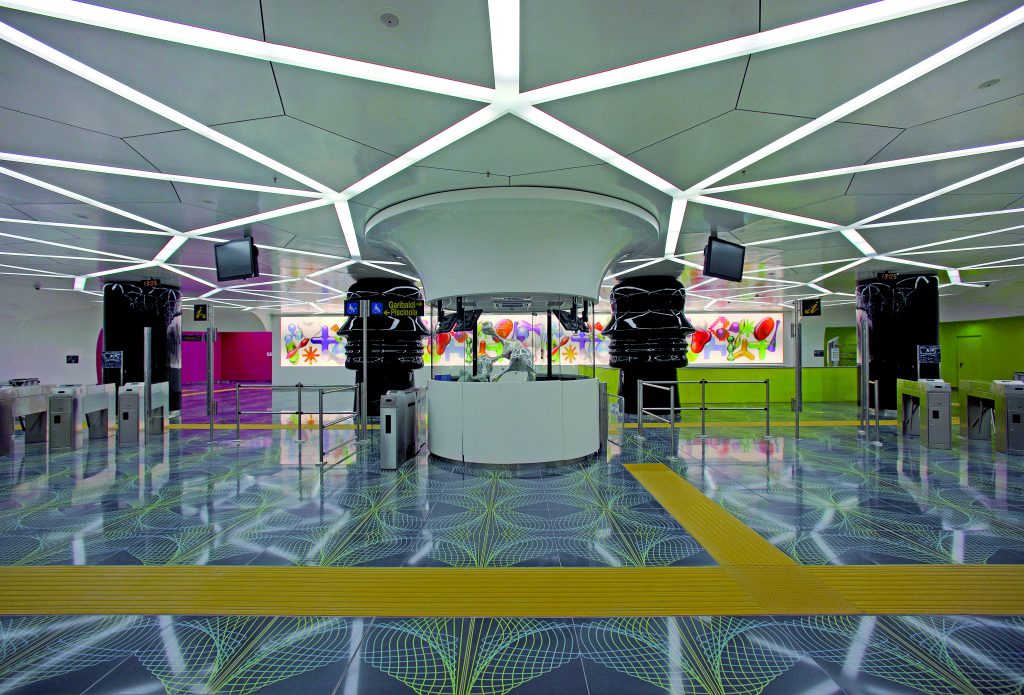
Behind them, Ikon Lenticular (2010) is a luminous work with moving figures via lenticular printing.
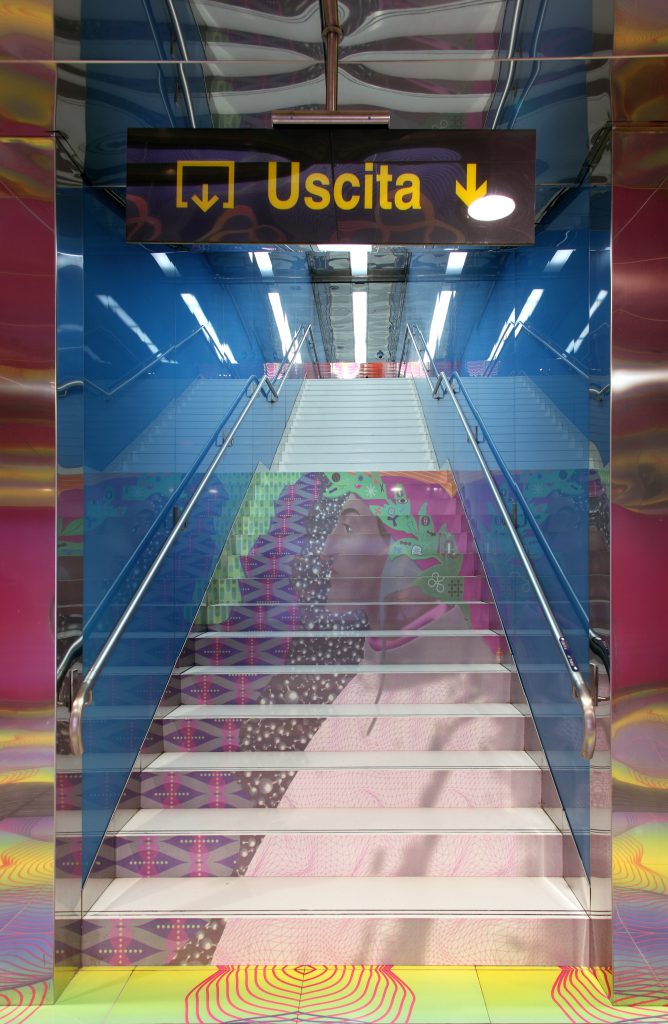
At the intermediate level are Fusion (2010) lightboxes (one per direction) and portraits of Dante and Beatrice on the stairs. The path continues with Transpose Blue and Transpose Lime; at platform level, H3D lenticular panels create the illusion of motion. Here you’ll also find Mutablob Pink (heart) and Mutablob Lime (mind)—a dialogue between art and urban flow. (Ph. P. Avallone)
Rounding out (for now) Line 1’s route are Duomo, Garibaldi, and Centro Direzionale, counted among the “art stations.”
Duomo
Situated on Corso Umberto I in Piazza Nicola Amore (nicknamed “The Four Palaces”), Duomo is one of Line 1’s most recently opened stations. Its construction coincided with an urban renewal that pedestrianized the square and removed the former roundabout.
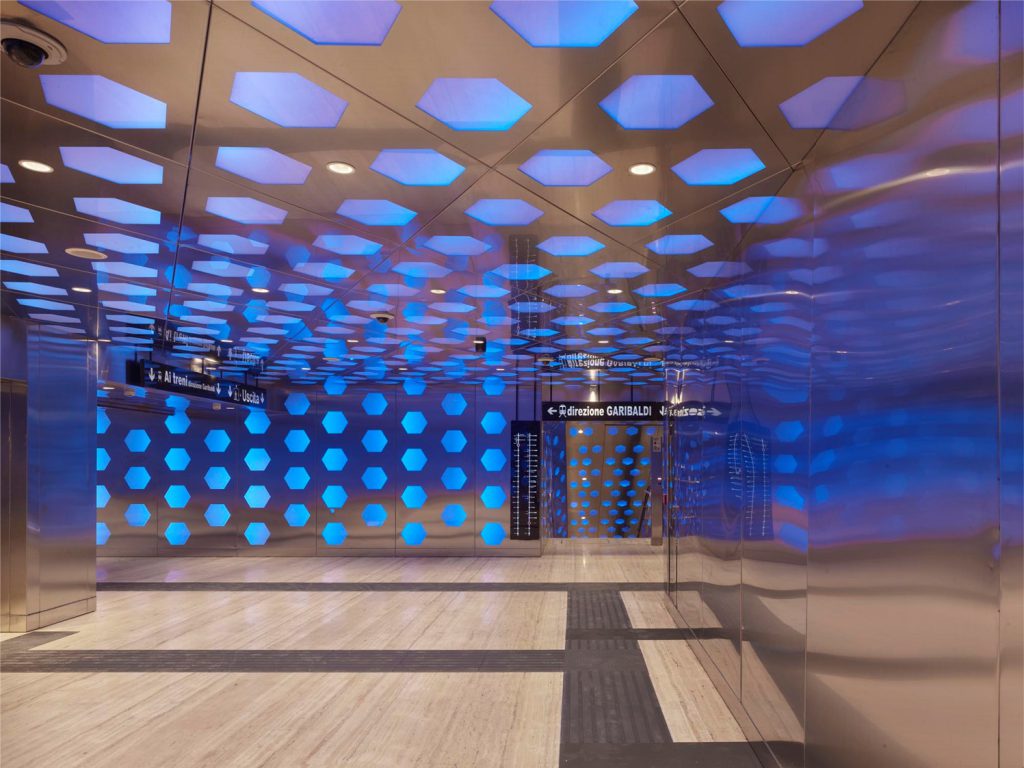
Inside, Massimiliano Fuksas’ design features hexagonal steel geometries backlit with multicolor LEDs, simulating a walk through the hours of the day—from pale dawn blue, to sunrise orange, to the dark hues of night.
Once completed, travelers will also be able to visit a museum level housing the Temple of the Isolympic Games. (© Metropolitana di Napoli)
Garibaldi
Garibaldi is the second of three completed interchange hubs, connecting Line 1 with Napoli Centrale (Line 2)—hence its nickname, “The Iron Gate.”
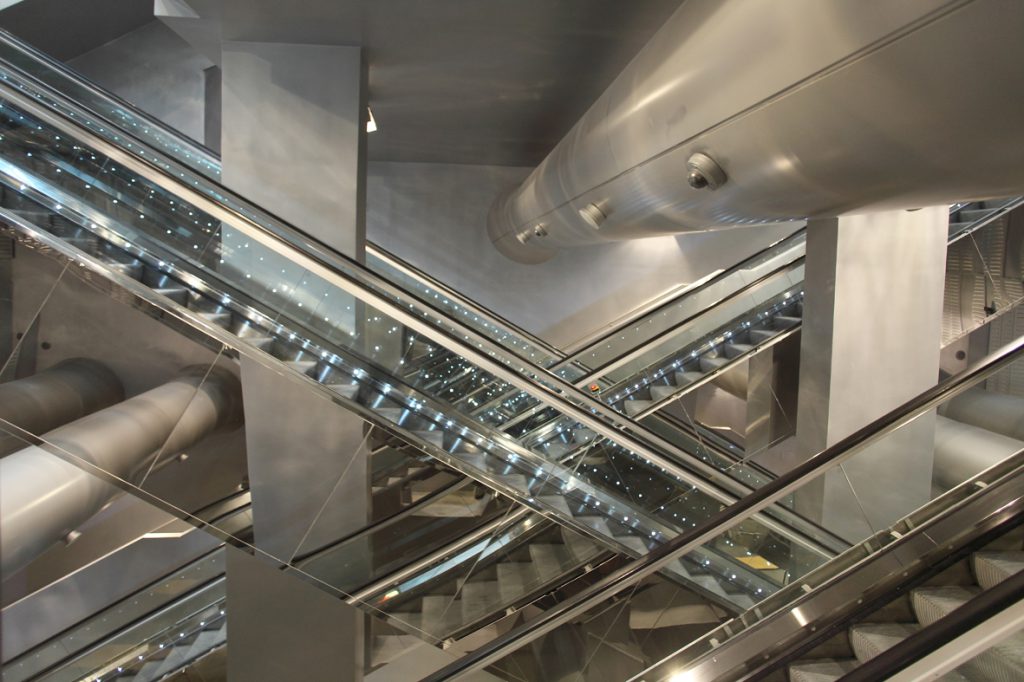
Conceived as a bright space, it features dramatic “suspended” escalators and satin or mirrored steel surfaces with vibrant orange accents. It forms part of the Art Stations System under the artistic direction of Achille Bonito Oliva.
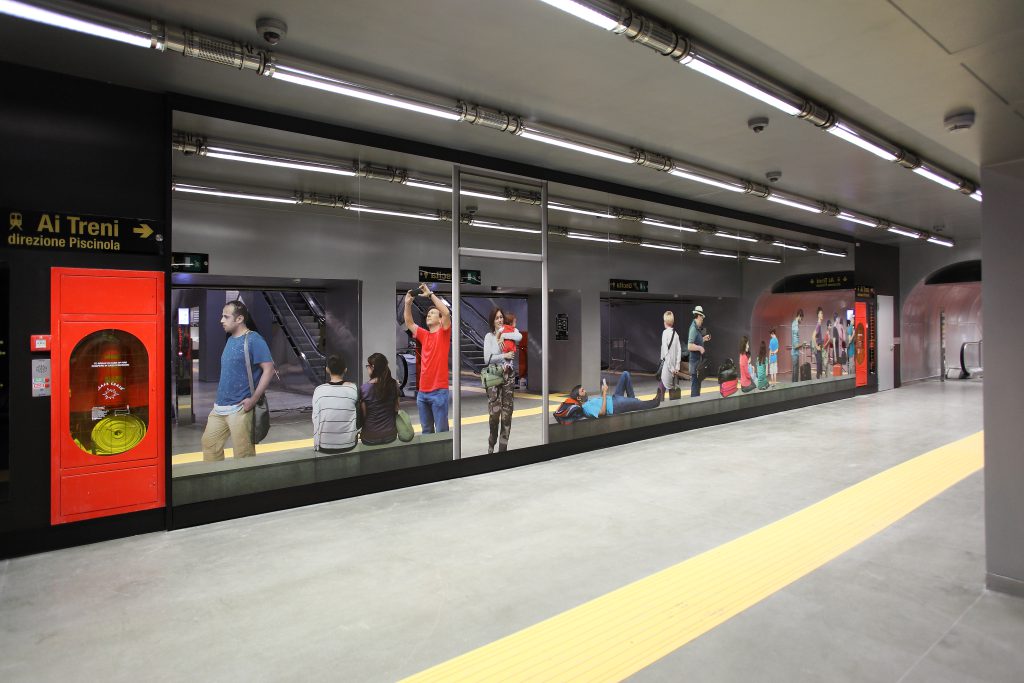
On the top intermediate floor are two works by Michelangelo Pistoletto, Stazione 1 and Stazione 2 (2013): mirror-steel panels showing life-size passengers, still or in motion, symbolizing a threshold between art and life where the traveler becomes part of the scene. (Ph. P. Avallone; © ANM)
Centro Direzionale
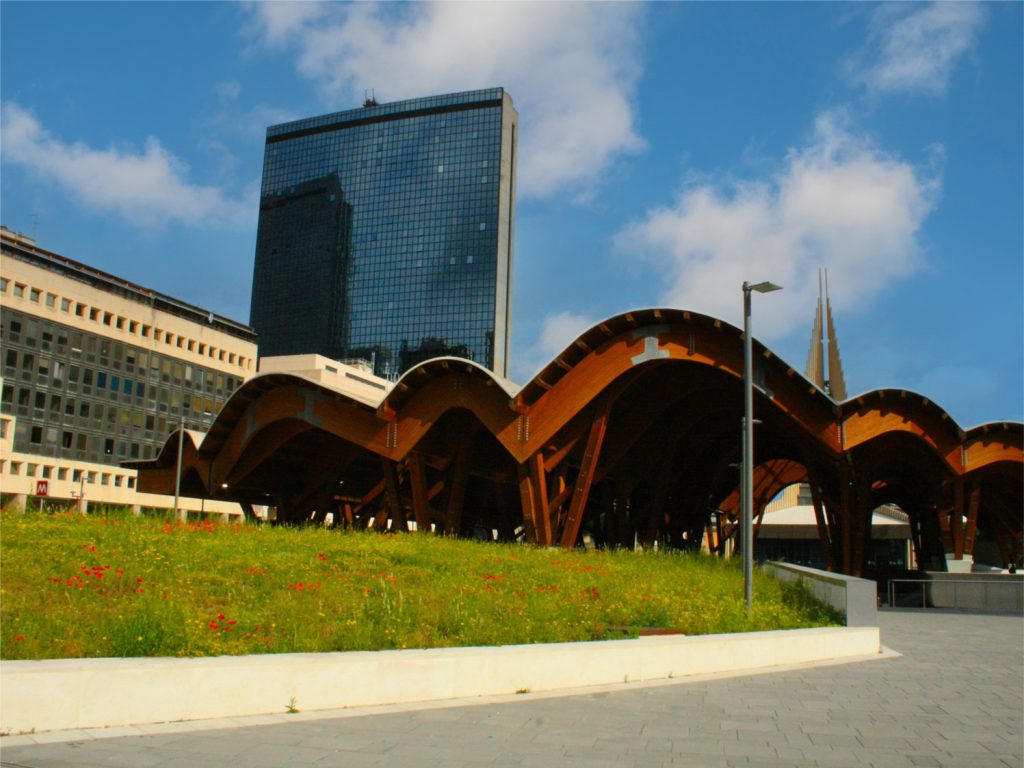
Designed by Benedetta Tagliabue and opened on April 1, 2025, Centro Direzionale has become a regional transport hub. In the heart of Isola F, home to many public offices, it enables interchange between Metro Line 1 and EAV’s Nola–Baiano line.
Spread over two levels—with central tracks and side platforms below—the station’s architecture is inspired by Naples’ morphology, creating a fluid, organic space that conveys the dynamism of the underground city.
The four dominant colors at platform level clearly reference Pompeian houses visible at the Pompeii excavations.

Above ground, the ticketing hall is covered by an undulating glulam timber structure supported by tree-like pillars, evoking an urban forest. The surrounding multilevel pedestrian area, bathed in natural light, culminates in a large hypogean plaza—a new space for welcome and social life.
The external canopy is said to draw inspiration from the vaulted cisterns of the Piscina Mirabilis in Bacoli. (© Metropolitana di Napoli)
With Line 1 complete for this tour, let’s discover Line 6, which links Municipio to Mostra.
Designed by Uberto Siola, Chiaia bridges two elevations, with entrances at Piazza Santa Maria degli Angeli (36 m) and Via Chiaia (25 m). Overlapping volumes—cylinder, cube, and a semi-spherical dome—channel natural light down to the platforms about 36 meters below. The station has single-bore twin tracks with side platforms.
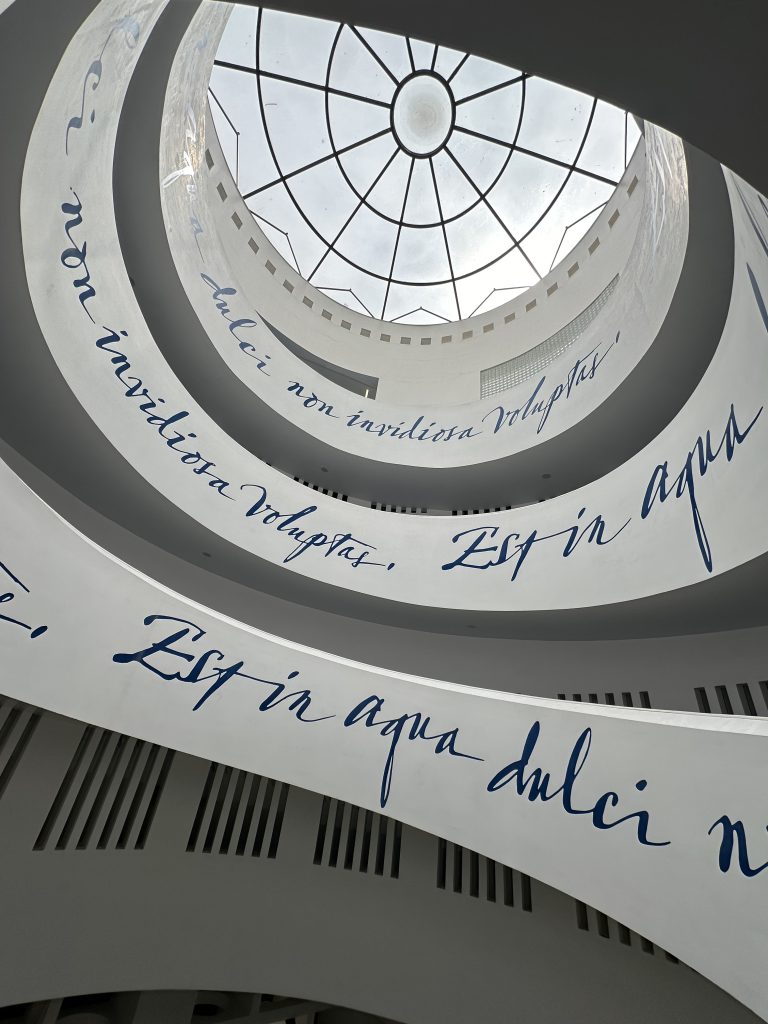
As part of the Art Stations System, it was curated by Peter Greenaway under Achille Bonito Oliva. Greenaway devised a mythological route: from Iupiter/Zeus in the square, through Neptunus/Poseidon’s marine realm, to Ceres/Demeter in a large green cube with copies of Farnese statues, descending into Proserpina/Persephone’s world among pomegranates, and finally to Hades, evoked by the intense red of the platform level and the “hundred-eyed” dome—the gaze of Pluto.
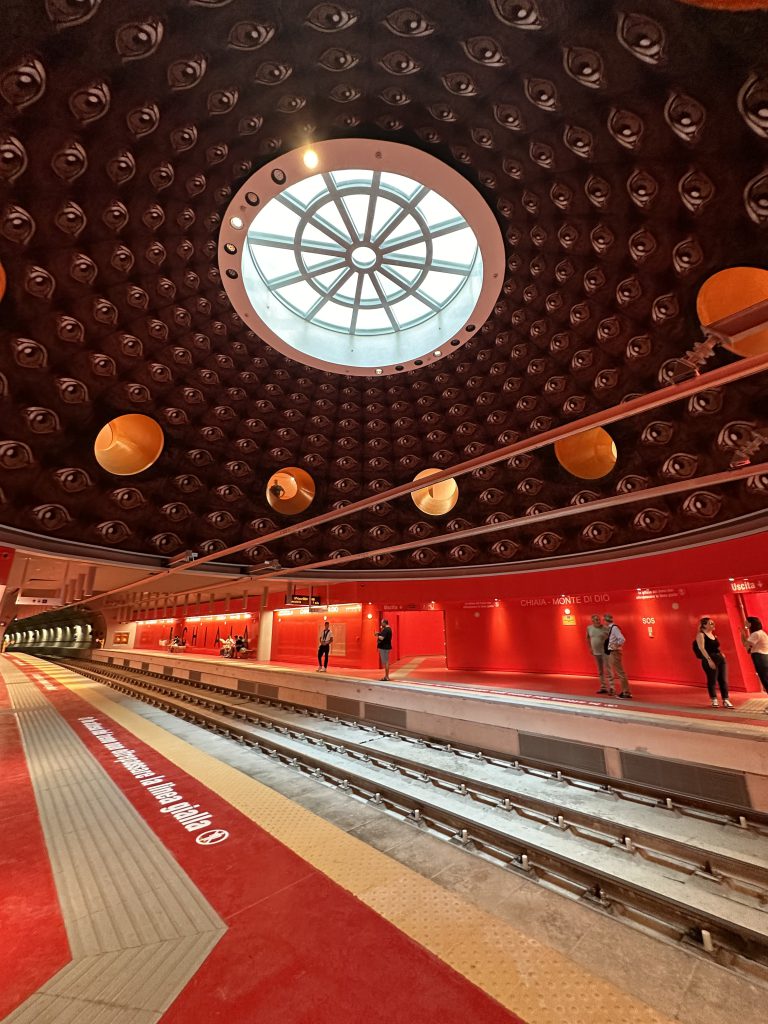
On December 2, 2024, Chiaia received Prix Versailles 2024, placing second in the Railway Stations category (after New York’s Grand Central Madison).
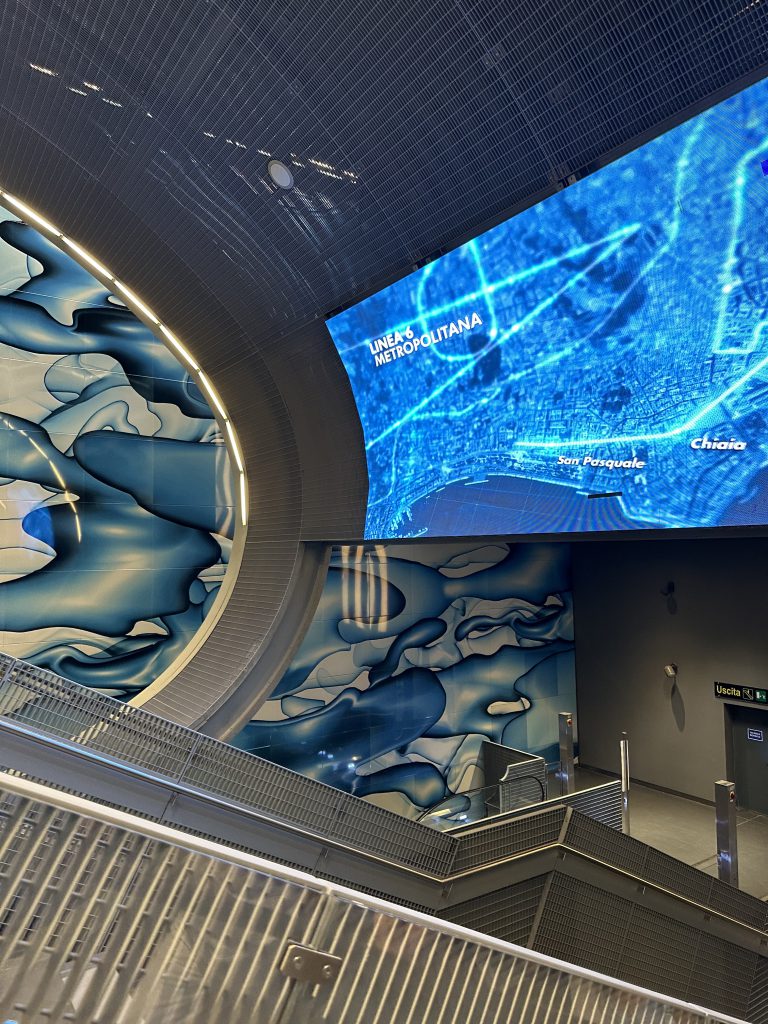
The construction of San Pasquale revitalized Largo Pignatelli, transforming it into a seaside-inspired piazza with rock-like benches, wave-pattern paving, and new trees. The five-level structure—about 100 m long and 35 m high—evokes a sunken wreck.
The marine immersion is enhanced by Peter Kogler’s blue modular panels simulating waves, and a yellow mesh with videowall at ticketing level recalling a ship’s sail. Luminous portholes in corten-steel walls light the platform level, about 26 meters deep. The station has single-bore twin tracks with side platforms.
Artistically, Boris Podrecca contributed a Benedetto Croce letter applied to the sides of the external lift tower.
Also part of the Art Stations (coord. Achille Bonito Oliva), San Pasquale won the BigSEE Architecture Award in 2025.
Arco Mirelli features an elegant glass-and-steel entrance pavilion by Hans Kollhoff, inspired by the pavilions of the 1900 Hygiene Expo in the Villa Comunale. The pavilion brings daylight to five underground levels finished in Tivoli travertine and Pietrarsa stone. A smaller circular pavilion on Viale Dohrn near the Tennis Club serves as an exhibition hall.
With single-bore twin tracks and side platforms about 26 meters deep, the project also redeveloped Piazza della Repubblica with new trees and reorganized traffic.
Within the Art Stations circuit, the intermediate level hosts an installation by Rebecca Horn (curated by Achille Bonito Oliva) comprising thirty copper horns, twelve holding mirrored discs that cast luminous reflections, accompanied by André Baum’s composition Sound Piece for Naples Metro, built from voices and sounds recorded in the city and Campania’s archaeological sites—intensifying the passenger’s immersive experience. (© Metropolitana di Napoli)
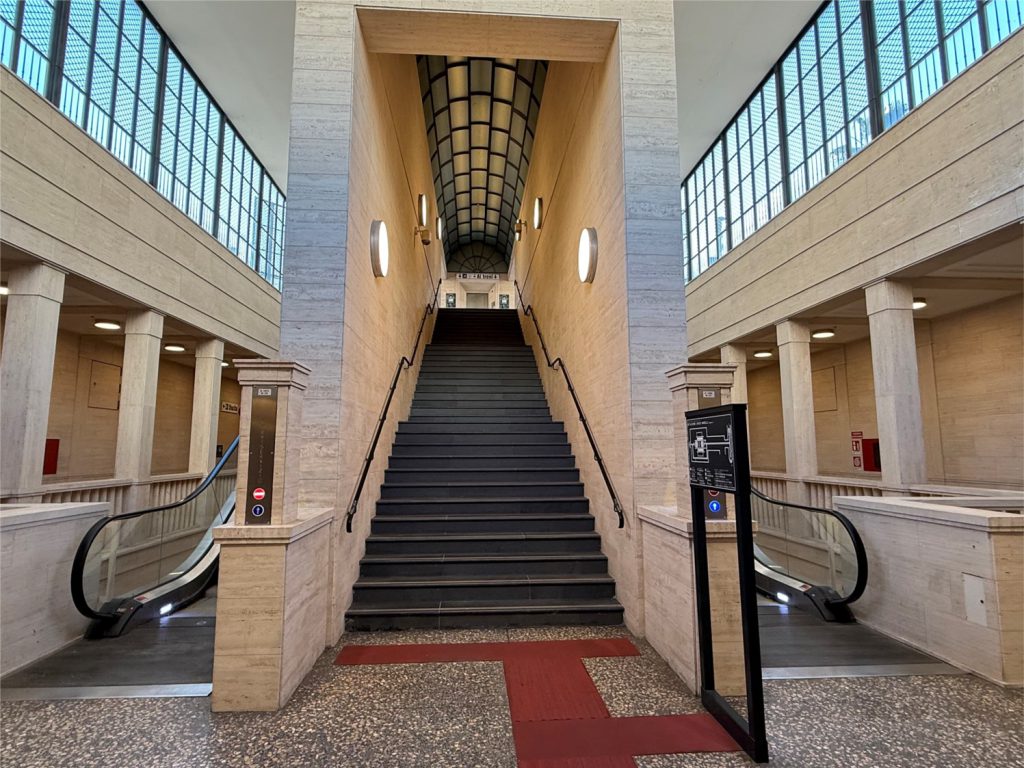
Naples’ art stations have often served as film sets.
Toledo was the backdrop for Ferzan Özpetek’s film Napoli velata.
At Municipio, scenes with a distinctly American vibe were filmed for Nike’s global spot launching the NOCTA line with rapper Drake—featuring a bunny on a motorbike racing from the entrance down to the platforms, chased by a “villain” on a train. In Naples, it seems, even a motorcycle can be chased by a train.
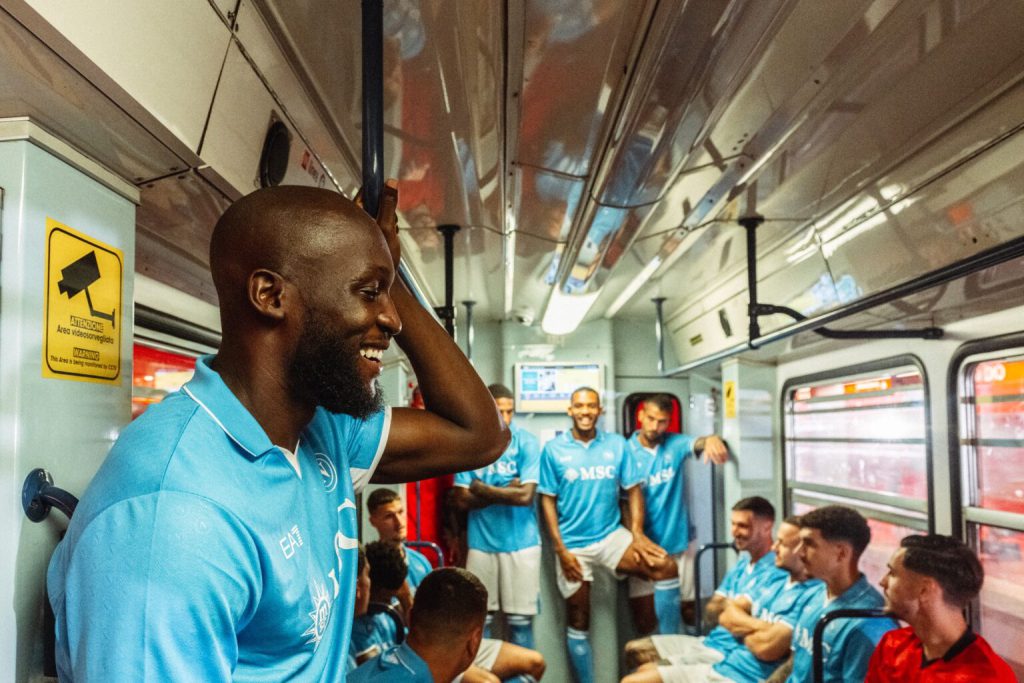
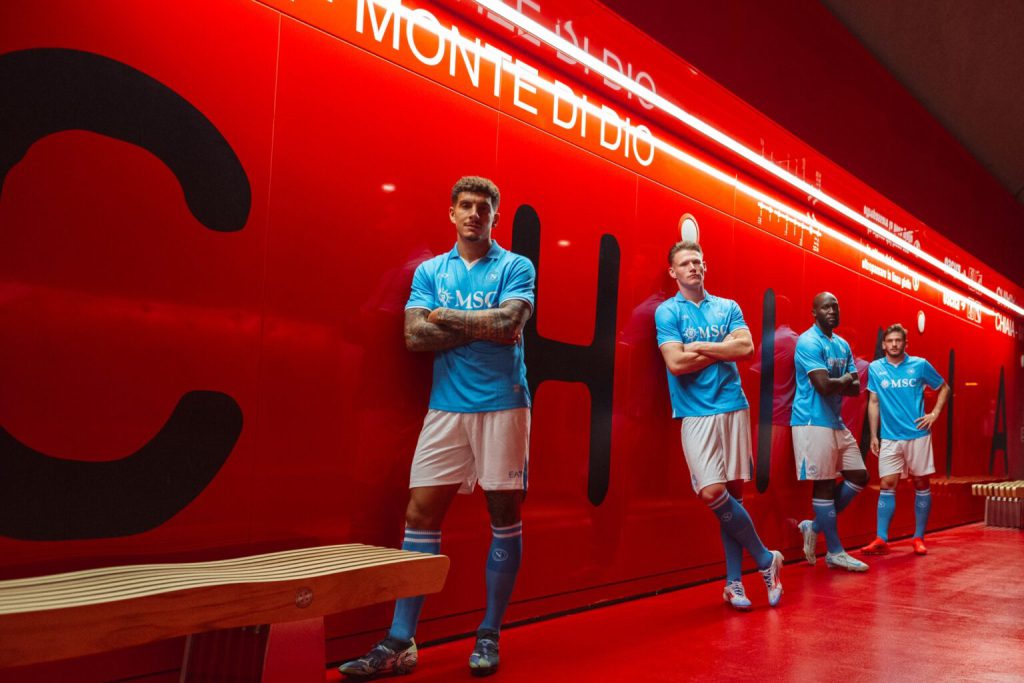
Chiaia, winner of the Grand Prix de Versailles, also brought good luck to Italy’s new champions: in a tightly secured setting, the photo later used in SSC Napoli’s annual calendar was taken there—proof that in this city you might even find the team captain acting as a train conductor. (© SSC Napoli)
There would be far too much to say about Naples’ art stations—dozens of articles wouldn’t suffice to capture their artistic depth. We hope soon to cover the other stations we didn’t mention here, with dedicated content for our readers.
To explore ANM services, click here.

There is a sound that never fades. Not the kind that dissolves into the air, but that of bronze bell...

In small, middle-class Milan, near the Villaggio dei Giornalisti, temporary housing units were built...

We are in the early 1960s. On one side there is Enzo Ferrari, the "Drake", absolute monarch of the a...

From April 13 to 16, 2026, the Bologna Children’s Book Fair returns for its 63rd edition. Once again...

In 1291, Doge Pietro Gradenigo signed a decree that would forever change the history of European cra...

Tornano sabato 21 e domenica 22 marzo le Giornate FAI di Primavera, il più grande evento di pia...
Rivista online registrata al Tribunale di Napoli n. 43 del 23/03/2022
Direttore: Lorenzo Crea
Editore: Visio Adv di Alessandro Scarfiglieri
Insight italia srl (concessionario esclusivo)
Rivista online registrata al Tribunale di Napoli n. 43 del 23/03/2022
Direttore: Lorenzo Crea
Editore: Visio Adv di Alessandro Scarfiglieri
Insight italia srl (concessionario esclusivo)
