
Autore: Redazione • 17/09/2025 16:27
Naples has always been a city of contrasts — a place where reality and legend, faith and superstition, the sacred and the profane coexist and intertwine.
This duality is deeply rooted in the city’s soul and in the hearts of its people, who have been bound for centuries to one of the most distinctive symbols of Neapolitan identity: the miracle of San Gennaro.
Let’s take a closer look at this ancient tradition — its legend, ritual, devotion, and the lingering doubts that surround it — all of which make it one of the beating hearts of Neapolitan culture.
.jpeg)
San Gennaro, now the patron saint and protector of Naples, was Bishop of Benevento, martyred on September 19, 305 AD, during the persecution of Christians under the Emperor Diocletian.
According to tradition, after his beheading, a devout woman named Eusebia, his nurse and follower, collected his blood in two glass vials.
From that moment on, this relic became an object of deep veneration — and the centrepiece of one of Christianity’s most enduring mysteries.
For centuries, Neapolitans have believed that the saint’s blood miraculously liquefies three times a year, in front of thousands of witnesses, in a ceremony that fuses religion, folklore, and the unique spirit of Naples.
Over time, devotion to San Gennaro grew ever more intense. Many faithful even requested to be buried near his relics, while others offered precious gifts in gratitude, contributing to the creation of the Treasury of San Gennaro, one of the most valuable collections of sacred art in the world.
.jpeg)
According to tradition, the miracle occurs three times a year:
Despite the passage of time, the devotion remains unwavering. Each year, thousands of people crowd into the Cathedral, waiting for the signal: when the white handkerchief held by the officiating priest is waved, it announces that the miracle has occurred and the blood has liquefied once again.
Among the most colourful participants in the ceremony are the famous “parenti di San Gennaro” — the “relatives” of San Gennaro.
These are mostly elderly women from the people, who claim a spiritual kinship with the saint.
They fill the Cathedral with songs, invocations, and pleas, convinced that their voices and faith help the blood regain its vitality and flow once again.
In popular tradition, these women are considered the descendants of San Gennaro and Eusebia — hence the term parenti (relatives).
Their devotion is so intimate that they affectionately call him “faccia ‘ngialluta” (“yellow face”), a reference to the golden hue of the saint’s bust.
If the blood delays in liquefying, they even scold the saint, as if rebuking a stubborn child. For them, San Gennaro is not merely a patron saint — he is a son to be coaxed back to life, through chants, tears, and an unwavering faith that has defied time.
While believers see the liquefaction as a divine miracle, science still regards it as an unresolved enigma.
In an article published in Nature, researchers from CICAP, led by Luigi Garlaschelli, claimed to have reproduced a substance with the same colour and behaviour as the saint’s blood by mixing molysite (a mineral found near Vesuvius) with salt and calcium carbonate.
According to their hypothesis, the phenomenon could be explained by thixotropy — a property that allows certain substances to shift from a solid to a liquid state when agitated.
However, Abbot Vincenzo De Gregorio, who has guarded the vials for over a decade, maintains that the blood’s behaviour is completely unpredictable.
Sometimes, he says, it liquefies even before the ampoule is removed from its safe, while other times, nothing happens at all.
Spectrometric analyses have confirmed the presence of blood components, but other scientists have offered different explanations.
The French physicist Michel Mitov, in his book Matière Sensible, suggested the ampoule might contain spermaceti (a waxy substance from sperm whales) mixed with clay — materials known to react to temperature and movement.
Despite experiments replicating thixotropic substances similar to the one in the ampoule, no direct analysis of the relic has ever been permitted, leaving the phenomenon suspended between faith and science — and, for many, still a true mystery.
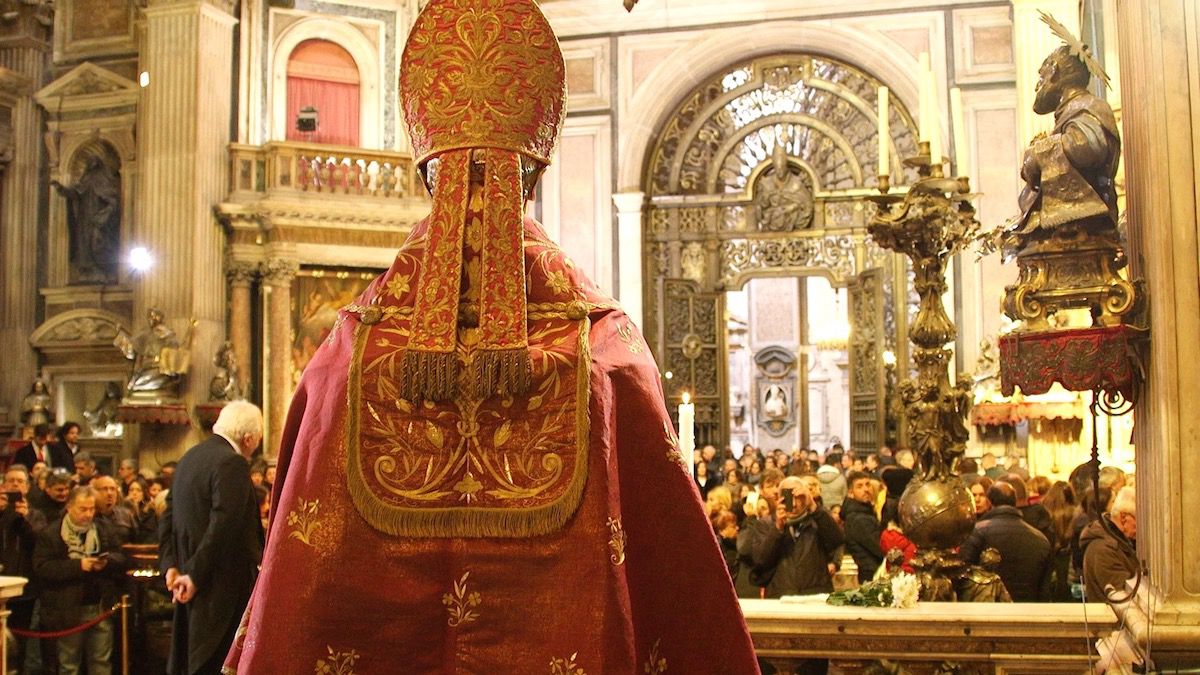
Whether one believes it to be a miracle or a natural phenomenon, one thing is certain: the bond between the people of Naples and San Gennaro is profound and unbreakable.
He is not just the city’s patron saint — he is a familiar presence, a source of hope and reassurance in times of hardship.
As long as his blood continues to liquefy, Neapolitans will believe that their protector watches over them, that light will always shine, even in the darkest moments.
Photo credit: cappelladisangennaro.it

There is a sound that never fades. Not the kind that dissolves into the air, but that of bronze bell...

In small, middle-class Milan, near the Villaggio dei Giornalisti, temporary housing units were built...

We are in the early 1960s. On one side there is Enzo Ferrari, the "Drake", absolute monarch of the a...

From April 13 to 16, 2026, the Bologna Children’s Book Fair returns for its 63rd edition. Once again...

In 1291, Doge Pietro Gradenigo signed a decree that would forever change the history of European cra...

Tornano sabato 21 e domenica 22 marzo le Giornate FAI di Primavera, il più grande evento di pia...
Rivista online registrata al Tribunale di Napoli n. 43 del 23/03/2022
Direttore: Lorenzo Crea
Editore: Visio Adv di Alessandro Scarfiglieri
Insight italia srl (concessionario esclusivo)
Rivista online registrata al Tribunale di Napoli n. 43 del 23/03/2022
Direttore: Lorenzo Crea
Editore: Visio Adv di Alessandro Scarfiglieri
Insight italia srl (concessionario esclusivo)
