
Autore: Redazione • 01/08/2025 09:20
Imagine choosing a romantic, lush location with a breathtaking sea view to build your own castle — where would you go?
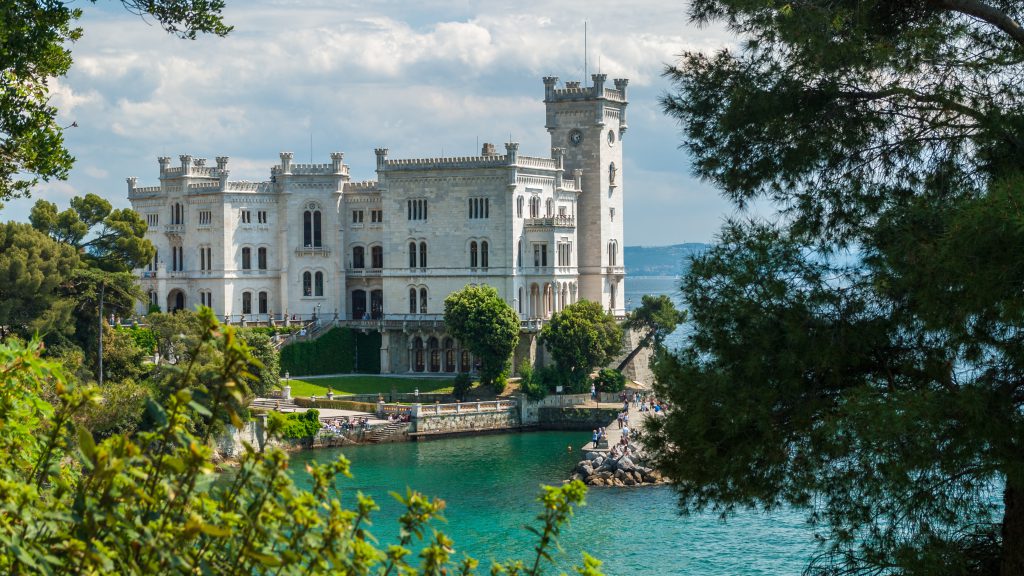
In the mid-19th century, Archduke Ferdinand Maximilian of Austria chose Trieste, overlooking the Gulf, as the setting for his dream residence: Miramare Castle, today a museum open to the public.
In 1855, during the Austro-Hungarian period, Archduke Maximilian fell in love with the panoramic beauty of the Grignano promontory near Trieste. He decided to build a luxurious residence where he could live with his wife, Charlotte of Belgium, in a place where the colors of the Mediterranean blended with grand European architecture.
Between 1856 and 1860, the castle was constructed under the direction of Austrian engineer Carl Junker. The result was an eclectic masterpiece, combining Gothic, Medieval, and Renaissance elements.
The name Miramare comes from the Spanish “mirar el mar” — “to look at the sea” — inspired by coastal Spanish castles overlooking the Atlantic.
Surrounded by a 22-hectare park, Miramare also reflects Maximilian’s passion for botany. His vision of a vast garden filled with rare species was realized by Bohemian gardener Anton Jelinek, who created rich soils and planted trees imported from around the world. Many plants came from Mexico, where Maximilian would later serve as Emperor — a reign that ended tragically in 1867, when he was executed by Republican forces. According to legend, his spirit still wanders the park at night, tending lovingly to its plants.
The story of the Archduke and his castle even inspired Giosuè Carducci, who immortalized it in his poem “Miramar” (part of the Odi barbare, 1877–1879), opening with an image of Miramare’s “white towers.”
After Charlotte’s return to Belgium, the castle became a temporary residence for members of the Habsburg family. Following World War I, it passed under Italian administration and was transformed into a museum in 1929, preserving the original 19th-century furnishings crafted by Franz and Julius Hofmann.
The museum features 22 rooms across two floors. At the ground floor, visitors find intimate private apartments decorated in sea-blue tones — the Archduke’s favorite color — evoking the atmosphere of a ship’s cabin. Even his study and bedroom mirror the interiors of a naval vessel, reflecting his role as commander of the Austrian navy.
The upper floor, used for official receptions, displays red tapestries and imperial symbols of the Habsburg-Lorraine dynasty, exuding grandeur and authority. Around 1932, Duke Amedeo of Aosta lived here for about seven years, re-furnishing the rooms in the contemporary style of the time.
The Miramare complex includes several smaller buildings: The Castelletto, a miniature version of the main castle, where the couple lived during construction; The Stables, once home to horses and carriages; The Greenhouses, for cultivating exotic plants; The Swiss Cottage, near the Swan Lake; A coffee house (Kaffeehaus) at the end of the garden terrace; The ruins of a chapel dedicated to Saint Cancian.
Today, Miramare Castle remains a jewel of Friuli-Venezia Giulia, blending romanticism, art, and nature in perfect harmony.
For more information, visit the official website.
Cover photo credit: Official website, Castello di Miramare

Rome Foundation Day 2026: four days celebrating the city's monuments From 19 to 22 April Rome offers...

Corinaldo Water Walk: springs, wells and the village’s history On Sunday 19 April, the Corinaldo bra...

Galleria Borghese in Cuneo: public response and figures The exhibition Galleria Borghese. From Rapha...

Sibari: 46 artifacts returned to the museum after international recovery On April 15, 2026, 46 archa...

Montecatino: a place where history endures Perched at 483 m above sea level, Montecatino is a compac...

Water and the Etruscans: conference overview in Grotte di Castro The fourth annual conference "Water...
Rivista online registrata al Tribunale di Napoli n. 43 del 23/03/2022
Direttore: Lorenzo Crea
Editore: Visio Adv di Alessandro Scarfiglieri
Insight italia srl (concessionario esclusivo)
Rivista online registrata al Tribunale di Napoli n. 43 del 23/03/2022
Direttore: Lorenzo Crea
Editore: Visio Adv di Alessandro Scarfiglieri
Insight italia srl (concessionario esclusivo)
