
Autore: Redazione • 31/10/2025 15:30
In the heart of Spoleto, along the historic Via Sant’Agata, stands a place where past and present intertwine with intensity: the National Archaeological Museum and Roman Theatre of Spoleto. This complex is not just a tourist destination, but an experience that invites visitors to step back in time — to physically touch the traces of civilizations that shaped the identity of a city and, in part, an entire region.
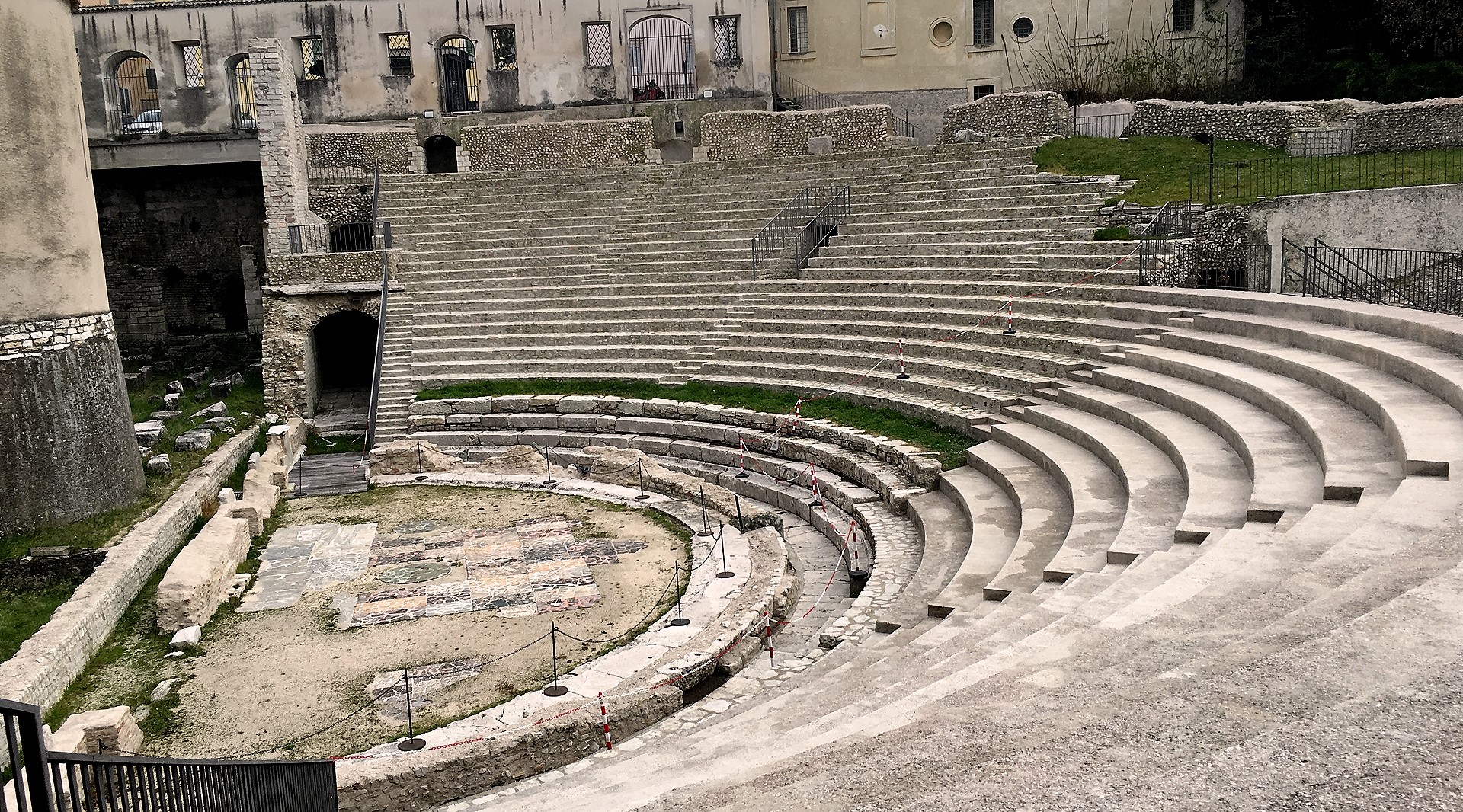
The museum is housed in the former Benedictine monastery of Sant’Agata, dating back to the 14th century, built on and around the remains of the Roman theatre.
The theatre itself dates to the 1st century BC and still features visible seating tiers, orchestra, and parts of the ambulatory.
This layering — ancient theatre → monastery → museum — tells not only of different eras, but also of the evolving functions and meanings of the same place over the centuries.
Inside the museum, the exhibition path guides visitors from the earliest human traces in the Spoleto area through the Roman period and beyond.
Artifacts from the Bronze Age, Umbrian phases, and Roman colonization are on display: urns, vases, weapons, inscriptions, marble pieces.
One particularly significant object is the statue of “Aura,” a Greek marble sculpture from the 5th century BC, reworked in Roman times as Venus — a testament to the interaction between Greek culture and the Roman world.
The museum is not just a “container” of objects, but a narrative of identity: Spoleto’s, Umbria’s, and Rome’s. It tells how the city developed, adapted, and reinvented itself.
Exiting the museum, visitors enter the Roman theatre: an imposing structure for its time, with a cavea diameter estimated at around 70 meters.
The artificial platform on which it stands, the semicircular ambulatory, the access through “vomitoria,” and the polychrome marble flooring in the orchestra all reflect the architectural and functional splendor of the Roman theatre.
Today, this theatre is not just a relic — it’s still a stage. The space hosts cultural events, performances, and concerts — a direct bridge between antiquity and the contemporary use of ruins, brought back to life through public participation.
Visiting the National Archaeological Museum and Roman Theatre of Spoleto means much more than seeing “artifacts”: it’s about touching the continuity of time.
Walking through the museum’s halls is like moving through eras, witnessing the succession of civilizations, cultures, and ways of life.
Entering the Roman theatre is experiencing a space that welcomed spectators two thousand years ago and still has the power to move today.
Spoleto’s urban setting — with its hills, walls, and alleys — gives the visit a human dimension: not an isolated museum, but one immersed in the life of the city.
Address: Via Sant’Agata, 18/A – 06049 Spoleto (PG)
Opening hours: Thursday to Sunday, 08:30 AM to 7:30 PM. Closed Monday to Wednesday.
Tickets: Full price €4.00; reduced €2.00. Free admission for minors under 18 and other eligible categories.
Special visits and events: Evening openings during initiatives such as the European Heritage Days, with symbolic ticket prices and guided tours. (cultura.gov.it)
Cover photo: Ministry of Culture

Women in Science exhibition at the Ducal Palace of Sassari From April 23 to May 6, 2026 the Sala Duc...

What the festival is Spring in the heart of Sardinia is a distributed festival that, in spring 2026,...

There Are Other Fish In The Sea: water installation in Palazzo Strozzi's courtyardDanish collective ...

"Fairy Tales Are True…": inclusive exhibition extended to 24 May 2026 The exhibition "Fairy Tales Ar...

Queens on Stage. The art of Italian costume between film and theatre When: 17/04/2026 - 06/09/2026 W...

Slow weekends in Italy's villagesFor travelers who prefer a relaxed pace, Italy's small Bandiera Ara...
Rivista online registrata al Tribunale di Napoli n. 43 del 23/03/2022
Direttore: Lorenzo Crea
Editore: Visio Adv di Alessandro Scarfiglieri
Insight italia srl (concessionario esclusivo)
Rivista online registrata al Tribunale di Napoli n. 43 del 23/03/2022
Direttore: Lorenzo Crea
Editore: Visio Adv di Alessandro Scarfiglieri
Insight italia srl (concessionario esclusivo)
