
Autore: Redazione • 03/11/2025 17:02
In the heart of the Lazio Maremma, among fields scented with tuff and wind, stands a place where the power of nature meets the charm of antiquity: the National Archaeological Museum of Vulci, housed in the majestic Castello dell’Abbadia, just a few kilometers from Montalto di Castro (VT). Here, within the stone walls overlooking the Fiora River and the famous Devil’s Bridge, the history of the Etruscans and Romans finds its voice again, telling the story of one of the richest and most mysterious cities of southern Etruria.
Castello dell’Abbadia, built between the 12th and 13th centuries by Cistercian monks, rises on a rocky spur above the Fiora gorge—a breathtaking panorama where nature and archaeology intertwine timelessly. With its inner courtyard, towers, and walkways, the castle has hosted the museum since 1975, showcasing artifacts from the ancient city of Vulci, one of the most important Etruscan centers, flourishing between the 9th and 3rd centuries BCE.
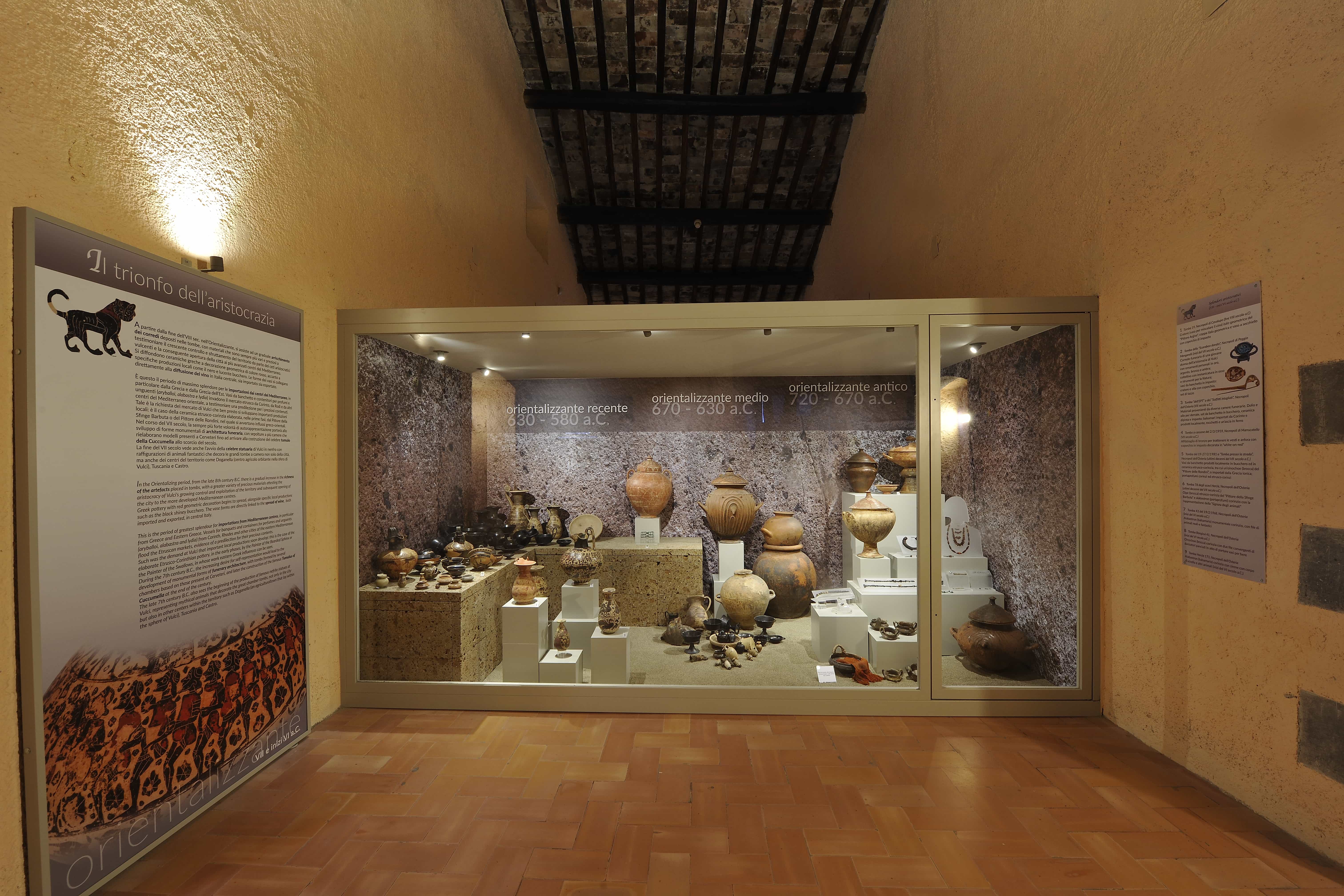
Stepping into the castle’s rooms, visitors are welcomed by objects that speak of daily life, trade, and art. There are elegant Greek ceramics imported via Mediterranean trade routes, as well as cinerary urns, bronzes, jewelry, weapons, and coins that reflect Vulci’s refinement and power.
Archaeological discoveries, begun in the 19th century, have revealed monumental necropolises such as Cuccumella and Cuccumelletta—true sculptural tombs that still impress with their grandeur. Each object in the museum is a fragment of a larger story, a silent dialogue between the Etruscans and our present.
The museum’s path follows Vulci’s journey from its origins to Romanization. From princely tombs of the Orientalizing period, with their sumptuous grave goods, to everyday Roman-era items, the arc of a city that opened itself to the world while preserving its identity is traced.
The visit doesn’t end within the castle walls: outside, in the Vulci Archaeological Park, visitors can admire the remains of city walls, temples, paved roads, and bridges that once connected the city’s heart to its river port—a true open-air journey through history.
Visiting the National Archaeological Museum of Vulci means encountering the past in a place where nature amplifies the voices of history. It’s an experience that engages all the senses: the sound of the river flowing beneath the bridge, the light filtering through arrow slits, the echo of footsteps on ancient paving stones.
Every room of the museum, every artifact, reminds us that Etruscan civilization is not a vanished world, but a living root that continues to speak to us of art, faith, and humanity.
Cover photo: Ministry of Culture

46 Etruscan, Magna‑Greek and Roman Artifacts Returned to the Archaeological Parks of Crotone and Sib...
Spring near L'Aquila: practical tips for visiting villages, lakes and highlands Spring changes the a...

Diamanda Galás opens Il Rumore del Lutto 2026 in Parma The Il Rumore del Lutto festival launches its...

Lombardy funds a new space for Gio Ponti at the ADI Design Museum The Lombardy Region has allocated ...

AR(TE)RRITORIO — group exhibition curated by Rino Tacchella On Saturday 18 April 2026 at 17:00 the g...

Vittorio Camaiani at Palazzo Colonna: "Senza Confini" Spring/Summer 2026 Designer Vittorio Camaiani ...
Rivista online registrata al Tribunale di Napoli n. 43 del 23/03/2022
Direttore: Lorenzo Crea
Editore: Visio Adv di Alessandro Scarfiglieri
Insight italia srl (concessionario esclusivo)
Rivista online registrata al Tribunale di Napoli n. 43 del 23/03/2022
Direttore: Lorenzo Crea
Editore: Visio Adv di Alessandro Scarfiglieri
Insight italia srl (concessionario esclusivo)
