
Autore: Redazione • 31/10/2025 16:19
In the heart of the Gioia Tauro Plain, among the sea, olive trees, and ancient whispers of civilization, stands the Archaeological Museum of Mètauros — a place where time is not merely recorded, but made present, tangible, and told with the passion of those who have discovered that history lives not only in books, but in the hands that shaped it.
The ancient city of Metauros (now visible only through excavations and artifacts) was founded as a Greek colony by settlers from Zancle (modern-day Messina) and Reggio Calabria, with strong commercial and cultural ties to Magna Graecia and the Tyrrhenian Sea.
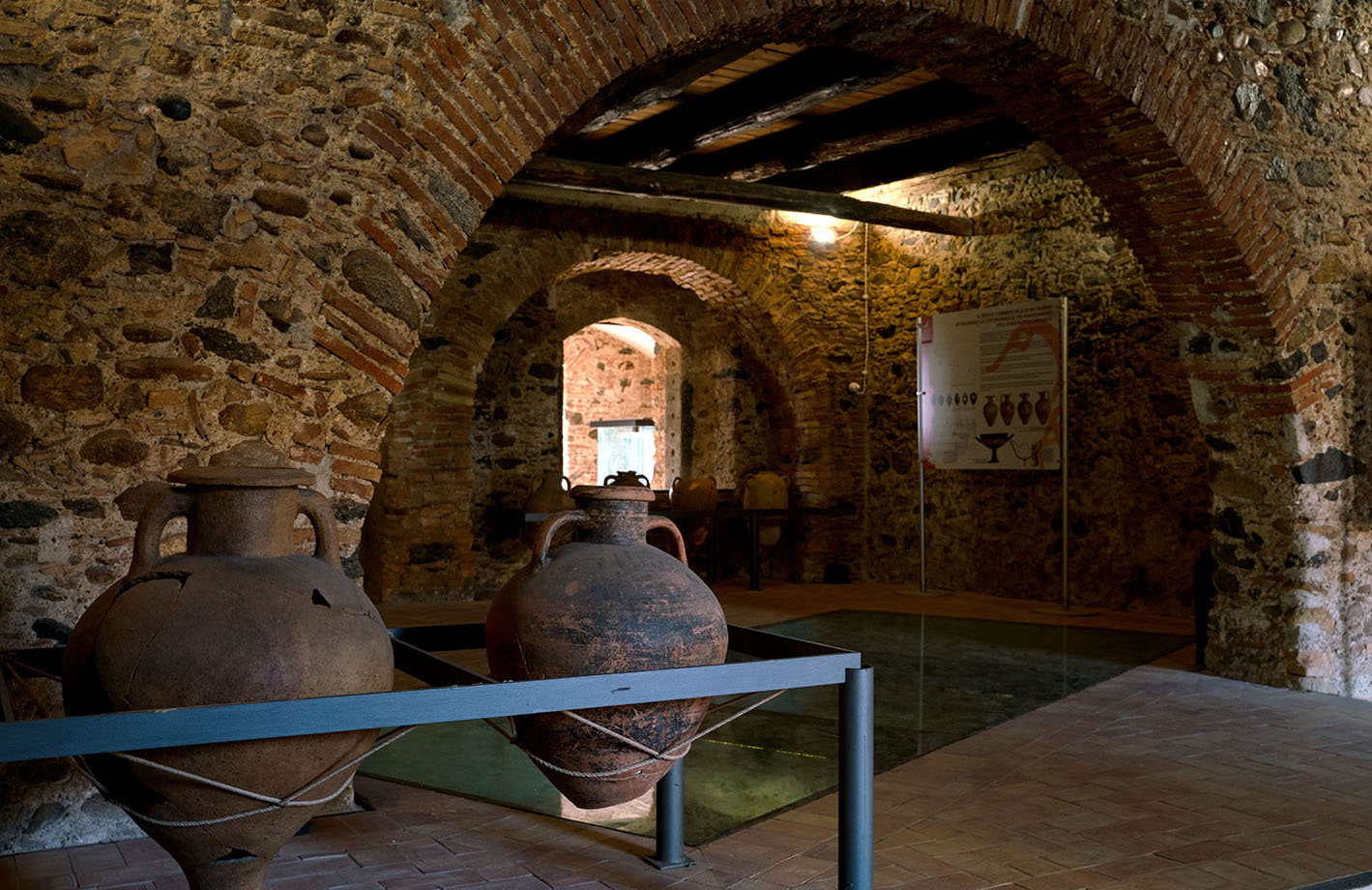
The museum is housed in a historic building, Palazzo Baldari, dating back to the 18th century, located in the village of Piano delle Fosse.
This combination of architecture and ancient artifacts gives visitors the sensation of walking through overlapping eras, in a continuous dialogue between the present and the past.
The museum’s collection largely comes from the vast archaic necropolis in the area, dated between the 7th and 5th centuries BCE.
Among the most moving testimonies are funerary items that tell of trade, exchanges, and relationships between Metauros and other Greek and Italic city-colonies: transport amphorae, Attic black-figure vases, alabasters, aryballoi, and votive objects.
One particularly striking item — a blown glass bottle with silvery iridescence — reveals that in the Roman era, during the 2nd–3rd centuries CE, the city was still inhabited and part of a Mediterranean trade network.
Walking among these display cases means meeting the gaze of those who lived here: the hands that wove, received, and placed the object in the tomb. It’s an experience that brings us closer to the human, not the monumental.
The Archaeological Museum of Mètauros is not just a repository of objects, but a place that welcomes the community. Workshops for children, simulated archaeological digs, moments of theater and poetry — all are ways to make the museum a shared experience.
For example, during the European Archaeology Days, the museum hosts special workshops for young people and themed guided tours, aiming to highlight the sense of continuity between the past and the present.
This approach makes the museum not just a place to visit, but a place to live. A meeting point between generations, between those who know and those discovering for the first time.
In a region often marked by challenges and transformations — economic, social, environmental — the museum takes on a special role: that of rooted memory, of storytelling that affirms the dignity of a territory.
Metauros is no longer just an ancient name, but a source of pride, a reference point for understanding that the Gioia Tauro Plain has deep roots, participated in exchanges, and maintained relationships that connected it to the Mediterranean world.
Visiting it means recognizing this history, and finding oneself, in some way, part of the thread that stretches across centuries.
Cover photo: Ministry of Culture

Women in Science exhibition at the Ducal Palace of Sassari From April 23 to May 6, 2026 the Sala Duc...

What the festival is Spring in the heart of Sardinia is a distributed festival that, in spring 2026,...

There Are Other Fish In The Sea: water installation in Palazzo Strozzi's courtyardDanish collective ...

"Fairy Tales Are True…": inclusive exhibition extended to 24 May 2026 The exhibition "Fairy Tales Ar...

Queens on Stage. The art of Italian costume between film and theatre When: 17/04/2026 - 06/09/2026 W...

Slow weekends in Italy's villagesFor travelers who prefer a relaxed pace, Italy's small Bandiera Ara...
Rivista online registrata al Tribunale di Napoli n. 43 del 23/03/2022
Direttore: Lorenzo Crea
Editore: Visio Adv di Alessandro Scarfiglieri
Insight italia srl (concessionario esclusivo)
Rivista online registrata al Tribunale di Napoli n. 43 del 23/03/2022
Direttore: Lorenzo Crea
Editore: Visio Adv di Alessandro Scarfiglieri
Insight italia srl (concessionario esclusivo)
